
Raspberry aphid
Amphorophora
Description
How to identify
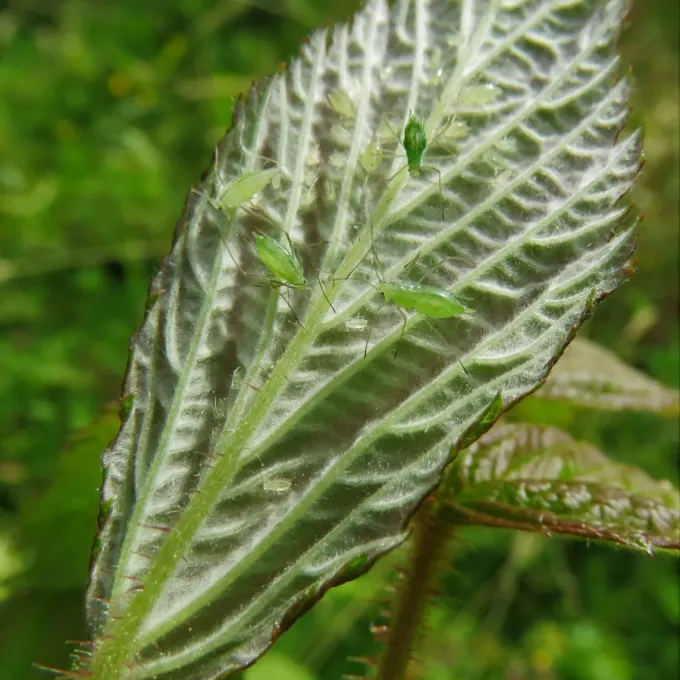
The raspberry aphid (Amphorophora rubi) is a small insect belonging to the family Aphididae. Adults typically measure about 3-4 mm in length and exhibit colors ranging from light green to yellow, often featuring prominent cornicles on their abdomen.
This species follows a complex life cycle, producing both wingless and winged forms. The winged individuals play a crucial role in the migration and rapid spread of the population across different parts of the field.
They overwinter as eggs, which are deposited by females in autumn on the stems of raspberry canes near the buds. As soon as spring arrives, these eggs hatch into founder larvae.
Throughout the growing season, multiple generations are produced in quick succession. Favorable weather conditions, especially mild temperatures and humidity, lead to explosive population growth.
The raspberry aphid is highly host-specific, primarily targeting plants of the genus Rubus, which includes raspberries and blackberries as their main food sources.
What it damages
The pest primarily targets young shoots, leaf petioles, and developing buds, where it forms dense colonies to feed on the plant's sap.
By constantly draining the cellular sap, the aphids weaken the plant significantly, reducing its vigor, overall growth, and capacity to survive harsh winter conditions.
A major threat is the aphid's role as a vector for various viral diseases, such as raspberry mosaic and leaf curl, which can devastate a plantation and cannot be cured.
The honeydew excreted by the aphids provides a breeding ground for sooty mold, which coats the foliage in a dark film and inhibits essential photosynthetic processes.
High infestation levels lead to reduced berry size, poor fruit quality, and lower overall yields, as damaged buds may wither and fall off prematurely.
When it appears
The activity begins in early spring as soon as buds break, marking the emergence of the first generation of larvae that feed on tender plant tissues.
Peak infestation usually occurs during late May and June, coinciding with the rapid growth of new canes and the migration of winged aphids between plants.
During the summer months, if left unmanaged, the population remains highly active, causing continuous stress to the plants throughout the vegetative growth stage.
As temperatures begin to drop in the autumn, the population transitions to the reproductive phase, focusing on laying eggs on the new growth for overwintering.
Environmental factors like heavy rainfall or natural predators play a significant role in fluctuating population levels throughout the gardening season.
Signs of infestation
The most visible sign of infestation is the curling and twisting of young leaves, particularly at the tips of the shoots, where colonies often hide.
Leaves affected by aphid feeding often become chlorotic, yellowing and eventually dropping off, which leads to thinning of the canopy and exposed stems.
The presence of a sticky, glistening substance known as honeydew on the leaves and stems is a clear indication that aphid colonies are present.
Stunted growth of the main shoots and the deformation of flowers or buds are common consequences of severe nutrient loss caused by the pests.
Careful inspection of the underside of the leaves usually reveals clusters of these small, pale insects clinging to the veins and soft tissue.
Control measures
Good agricultural practices, such as removing weeds and thinning out old canes, help reduce the habitats available for the aphids to thrive.
Systemic insecticides are the most common chemical solution, typically applied before the flowering stage to protect the plants during their most vulnerable period.
Biological control methods involve encouraging beneficial predators such as ladybirds, lacewings, and hoverflies, which can effectively keep aphid numbers in check.
Starting with certified virus-free planting stock is essential to prevent the introduction of both the aphids and the debilitating viruses they carry.
- Regular monitoring of the shoot tips during the growing season.
- Using insecticidal soaps for localized control in small gardens.
- Applying dormant sprays during late winter to eliminate overwintering eggs.
Taxonomy
- Latin name
- Amphorophora
- Order
- Hemiptera (bugs, aphids, leafhoppers)
- Family
- Aphididae
- EPPO code
- AMPHSP
Discussion
No discussions yet — be the first.