
Amauromyza leaf miner
Amauromyza karli
Description
How to identify
Amauromyza karli belongs to the family Agromyzidae, commonly known as leaf miner flies. This species is an specialized pest characterized by the larval stage living entirely inside the leaf tissue.
Adult flies are small, dark-colored insects with clear wings. They are highly mobile and can spread quickly across a field or greenhouse environment, identifying suitable host plants through chemical cues.
The life cycle consists of eggs, larvae, pupae, and adults. The female uses an ovipositor to insert eggs directly into the leaf surface, creating a small puncture which is often the first visible symptom of infestation.
Larvae are typically maggot-like, pale in color, and specialized for chewing through the mesophyll layer. They grow inside the leaf, making them protected from most environmental stresses and standard contact pesticides.
Pupation may occur inside the mine or in the soil, depending on the specific environmental conditions and the host plant type. Understanding this is crucial for timing effective control measures.
What it damages
The primary hosts for Amauromyza karli are plants within the Asteraceae family. Many weed species and ornamental plants serve as significant reservoirs for the population.
As the larva mines through the leaf, it consumes the green tissue responsible for photosynthesis. This depletion reduces the plant's energy production, leading to stunted growth and reduced crop yields.
Visually, the plant loses its commercial value due to the presence of unsightly trails and discolored leaves. This is particularly devastating for ornamental industries where leaf appearance is paramount.
Severe infestations can lead to premature leaf drop, which puts additional stress on the plant, potentially causing it to become more susceptible to other diseases and environmental pressures.
In addition to the physical damage, the punctures and mines create entry points for secondary pathogens like fungi and bacteria, which can cause rotting of the leaf tissue and further debilitate the plant.
Signs of infestation
The earliest signs of an infestation are tiny stippling marks on the leaf surface. These are caused by the adult female feeding on plant sap or creating spots to lay her eggs.
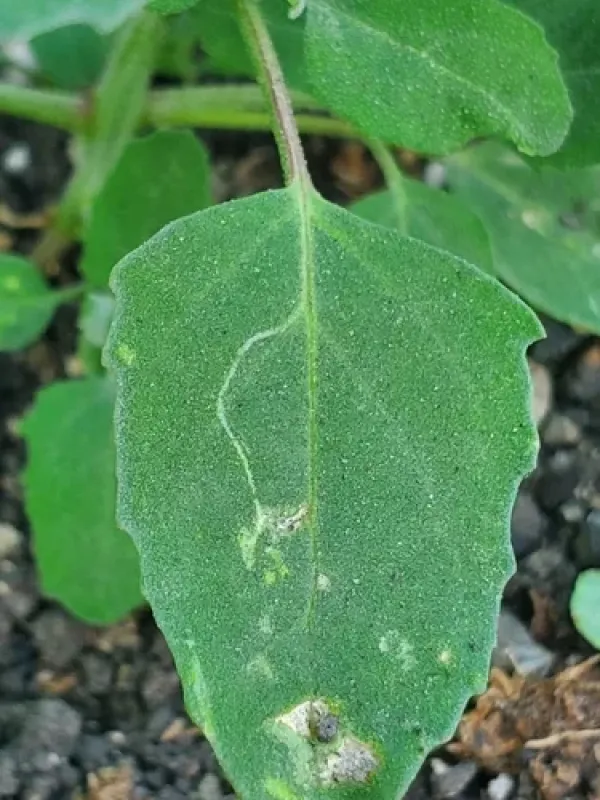
As the larva develops, it creates a visible, winding trail known as a mine. These mines often appear as light-colored or silvery tracks that increase in width as the larva matures.
A distinctive feature of many leaf miner activities is the presence of frass (larval excrement). It appears as dark particles arranged in patterns inside the tunnel, confirming the presence of an active larva.
Leaves affected by high populations may show signs of yellowing, desiccation, and curling. In many cases, the leaf may wilt entirely due to the extensive destruction of its internal structure.
Regular scouting is essential, as the symptoms start small and can easily be overlooked until the population reaches a point where significant damage is already done.
Control measures
Cultural control methods such as removing infested leaves and destroying crop residues help to break the life cycle by eliminating pupae and eggs before they develop further.
Biological control using parasitoid wasps (such as Diglyphus species) has proven to be an effective strategy in integrated pest management (IPM) programs for leaf miners.
Yellow sticky traps are highly recommended for monitoring and mass-trapping adult flies in enclosed cultivation environments like greenhouses, helping to reduce the overall population.
Chemical control must utilize systemic insecticides. These are absorbed into the plant sap, ensuring that the larvae inside the leaf are exposed to the toxicant during their feeding.
- Monitor fields for early stippling signs.
- Use yellow sticky cards for population suppression.
- Maintain weed control to limit host availability.
- Rotate crops to break the life cycle.
Taxonomy
- Latin name
- Amauromyza karli
- Order
- Diptera (flies)
- Family
- Agromyzidae
- EPPO code
- AMAZKA
Discussion
No discussions yet — be the first.