
Japanese many-plumed moth
Alucita japonica
Description
How to identify
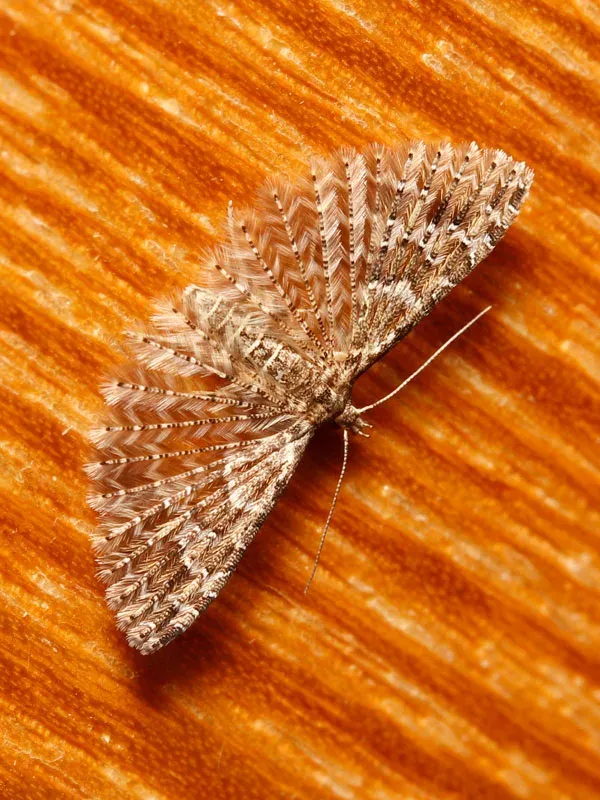
The Japanese many-plumed moth (Alucita japonica) belongs to the family Alucitidae, order Lepidoptera. Its name derives from its unique wings, which are deeply cleft into several distinct plumes, resembling a fan.
Adult moths are quite small and possess cryptic coloration, allowing them to blend seamlessly into bark or dry plant material, making them difficult to spot in the wild.
The larvae are typically cylindrical and hidden from view, feeding deep within plant structures. This concealed lifestyle is a primary challenge for pest monitoring and identification.
The evolution of such specialized wings provides the moth with remarkable maneuverability, aiding its movement through complex and dense vegetative environments.
Identification often requires examining host plants for specific larval damage or utilizing light traps at night, as these moths are primarily nocturnal in their behavior.
What it damages
This pest mainly targets plants in the Caprifoliaceae family, with honeysuckle being a primary host. Larvae feed on the internal tissues of buds, flowers, and developing ovaries.
Feeding damage causes buds to deform, wither, or drop prematurely, significantly impacting the potential harvest of berries and affecting ornamental flowering.
Infested flowers often fail to develop fruit, and any resulting berries may show severe scarring or structural defects, rendering them unfit for market.
The wounds created by larval feeding act as entry points for secondary pathogens, including fungi and bacteria, which can weaken the overall vitality of the plant.
In cases of high infestation, the cumulative damage can lead to a substantial loss of the entire flower crop, particularly in nursery or berry-producing setups.
When it appears
The life cycle of the Japanese many-plumed moth is closely linked to the phenological stages of its host plants, particularly the onset of flowering in spring.
Adult moths emerge and lay eggs directly on the buds, ensuring that larvae have immediate access to nutrients upon hatching, which aligns with the peak blooming period.
Developmental stages progress rapidly in favorable weather, with the total duration from egg to adult often taking only a few weeks, allowing for multiple generations per season.
Overwintering occurs in sheltered areas, typically as pupae or adults tucked away in bark crevices or among leaf litter, where they remain dormant until temperatures rise.
Warm, humid conditions generally act as a catalyst for increased metabolic activity and faster population growth in these insects during the spring and summer months.
Signs of infestation
Early symptoms of infestation include the wilting of buds and the appearance of malformed, twisted growth on the stems of honeysuckle and related species.
One can identify the presence of the moth by carefully inspecting buds, where small larvae may be found inside, along with their characteristic frass and waste.
Silken webbing found connecting flower buds is a key indicator of larval activity, as the pests use it to create protective enclosures while they feed.
Widespread dropping of unopened buds is a severe sign of heavy infestation, indicating that larvae have consumed the reproductive centers of the flowers.
On late-stage infestations, hollowed-out tissue in the flower base is visible, confirming the larvae have completed their feeding cycle before pupation.
Control measures
Managing the Japanese many-plumed moth requires a combination of cultural practices and targeted insecticide treatments to break the pest cycle.
Sanitation is critical; all fallen leaves and garden debris should be removed and destroyed during the autumn to eliminate overwintering sites.
Systemic insecticides are the most effective chemical control, as they can reach the larvae hidden inside the buds where contact sprays often fail.
- Manual removal of infested buds early in the season.
- Monitoring population levels using pheromone or light traps.
- Encouraging local populations of beneficial predatory insects and birds.
Timing is essential; applications should coincide with the emergence of the first generation to prevent widespread larval establishment within the flowering clusters.
Taxonomy
- Latin name
- Alucita japonica
- Order
- Lepidoptera (butterflies)
- Family
- Alucitidae
- EPPO code
- ORNEJA
Discussion
No discussions yet — be the first.