

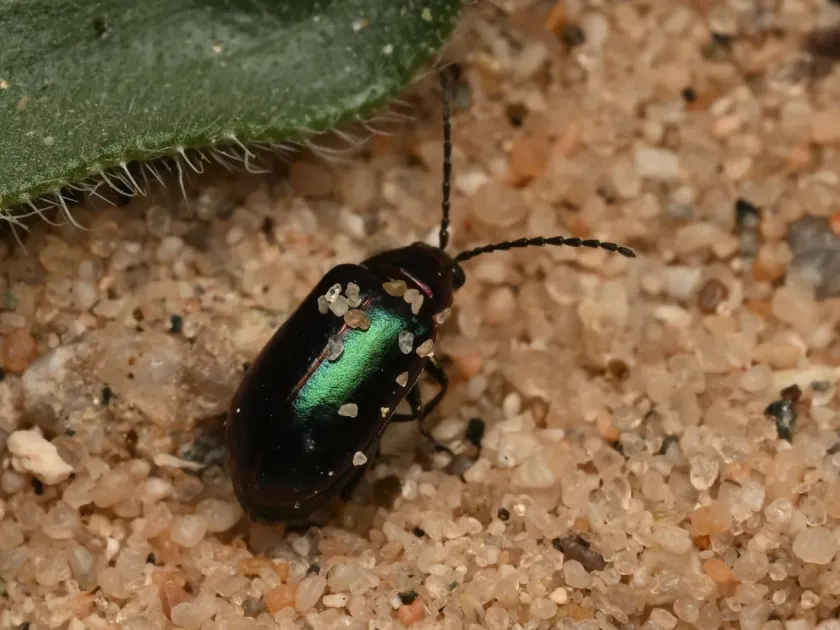
Description
How to identify
Flea beetles, belonging to the genus Altica within the Chrysomelidae family, are small, jumping beetles known for their capacity to devastate young crops.
They typically measure between 1.5 and 3 mm in length and are easily identified by their enlarged hind legs, which enable them to leap like fleas when disturbed.
Adult beetles often exhibit a metallic coloration, ranging from shiny black or bronze to vibrant blue or green, making them distinct under direct sunlight.
The larvae, which are small and worm-like with dark head capsules, mostly dwell in the soil, feeding on roots, although some species mine the leaves of host plants.
Overwintering occurs in the adult stage, where the beetles seek shelter in leaf litter, grass clumps, or the upper layers of soil, waiting for the arrival of spring temperatures.
What it damages
Flea beetles primarily target plants in the Brassicaceae family, including cabbage, radishes, broccoli, kale, mustard, and canola, causing significant economic damage.
The adults are responsible for the most noticeable harm, chewing tiny, pin-sized holes in leaves, which can lead to complete defoliation of tender seedlings within a few days.
Heavy infestations can lead to stunted growth or the total death of young plants, as the sheer number of feeding punctures disrupts the plant's ability to photosynthesize effectively.
Seedlings are at the highest risk, as their limited leaf surface area cannot withstand extensive damage, often leading to total stand failure if not protected early in the season.
The larvae feeding on root systems further contribute to the decline of the plant, often causing the crop to wilt or become susceptible to secondary soil-borne pathogens.
When it appears
Adult beetles emerge from their hibernation sites early in the spring as soon as ambient temperatures consistently reach approximately 12–15 degrees Celsius.
The peak period of activity and damage typically occurs during the late spring and early summer months, particularly when the weather is hot, dry, and sunny.
Flea beetles may complete one or several generations annually, depending on the specific species and the regional climate, which influences their reproductive rate.
Daily activity fluctuates, with beetles showing highest mobility during the warm parts of the day and seeking refuge in soil crevices or under foliage during intense heat or night.
As autumn progresses, the beetles gradually cease their feeding activity and relocate to protected hibernation sites to survive the winter months, completing their yearly life cycle.
Signs of infestation
The most diagnostic sign of flea beetle presence is the "shot-hole" pattern on leaves, where numerous small, circular holes appear on the foliage of susceptible seedlings.
A quick test to confirm the identity is to lightly brush the leaves of the affected plants; if the infestation is present, the beetles will rapidly jump away from the plant.
Yellowing or wilting of plants, despite adequate moisture, can often point to larval root damage, which restricts the plant's nutrient uptake and overall development.
Leaves may show white patches or "window-paning" effect where the beetles have consumed only the upper layer of the leaf, leaving the lower epidermis intact and translucent.
In cases of severe infestation, the growing point (apical meristem) may be consumed, leading to deformed or non-existent central growth, which drastically reduces plant vigor.
Control measures
Cultural practices are the first line of defense, including the use of floating row covers, which physically prevent beetles from landing on and feeding on emerging seedlings.
Maintaining a clean garden by removing weeds that serve as alternative hosts, particularly cruciferous weeds, significantly lowers the potential beetle population in the area.
Promoting rapid plant growth through optimal fertilization and regular irrigation can help seedlings reach a size where they can better withstand moderate beetle feeding pressure.
Chemical control using registered insecticides may be necessary during severe outbreaks, specifically targeting the beetles when they are most active on the foliage.
Organic alternatives such as kaolin clay sprays can act as a repellent by creating a protective barrier on the leaves, making them less attractive to the beetles' biting mouthparts.
Content graph
Connections · Flea beetle
Most often together:
Marketplace
Products · 3
Biology
Taxonomy
- Latin name
- Altica
- Order
- Coleoptera (beetles)
- Family
- Chrysomelidae
- EPPO code
- HALTSP
Community
Discussion
No discussions yet — be the first.