
Shizuoka whitefly
Aleyrodes shizuokensis
Description
How to identify
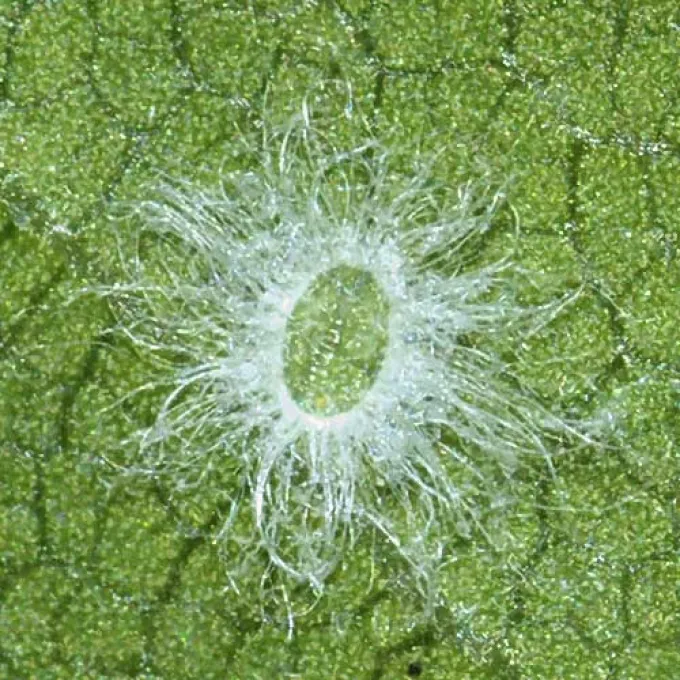
The Shizuoka whitefly Aleyrodes shizuokensis is a small insect belonging to the order Hemiptera and the family Aleyrodidae. These pests are characterized by a waxy white covering on their bodies.
Adults are tiny insects with two pairs of wings that fold in a roof-like manner over their bodies while at rest. Their typical body length is around 1.5–2 mm.
The life cycle involves larval stages; early instars (crawlers) are mobile, while later instars become sessile and firmly attach to the undersides of leaves.
Due to the morphological similarity among various whitefly species, accurate identification often requires microscopic examination of the pupal case (puparium).
Eggs are typically oval, deposited by females on the undersides of leaves, often arranged in circles or irregular clusters depending on the host plant species.
What it damages
This species is a polyphagous pest capable of infesting a wide range of agricultural and ornamental crops, frequently targeting broad-leaved woody plants.
Both adults and larvae cause direct damage by feeding on plant sap. This process saps the plant's vitality and disrupts normal metabolic functions.
Feeding leads to leaf chlorosis, yellowing, and deformation, which significantly reduces the aesthetic quality of ornamental plants and the vigor of crops.
The whitefly excretes honeydew, a sugary substance that coats the leaves and serves as a growth medium for sooty mold fungi, further hindering photosynthesis.
Severe infestations result in premature leaf drop, stunted growth, and an overall decline in plant health, making them more susceptible to environmental stress.
When it appears
The seasonal activity of Aleyrodes shizuokensis is largely dictated by temperature and humidity levels, which control the speed of their development.
In greenhouses or controlled environments, this pest can maintain continuous breeding cycles throughout the year if temperatures remain favorable.
In outdoor environments, peak activity is generally observed during the warmer months, starting from late spring and continuing through early autumn.
The rate of generation turnover depends on the accumulated heat units, allowing for multiple generations per year in temperate and subtropical regions.
As colder weather approaches, the population density typically decreases, with survivors seeking sheltered locations to overwinter until spring returns.
Signs of infestation
One of the earliest signs of infestation is the presence of white, scale-like colonies of larvae on the abaxial (bottom) side of leaves.
When an infested plant is disturbed, a cloud of tiny, white, moth-like adults will fly up, serving as a clear indicator of a significant infestation level.
A sticky residue on the foliage indicates the presence of honeydew, which is a hallmark sign of whitefly feeding activity in the area.
Black, powdery soot-like deposits appearing on leaves signify that sooty mold has colonized the honeydew, pointing to an advanced stage of infestation.
Visible leaf curling and a lack of new shoot development are common secondary signs caused by the chronic loss of plant nutrients.
Control measures
Mechanical control involves the regular inspection of plants and the physical removal of infested leaves to lower the overall population count.
Yellow sticky traps are highly effective for monitoring whitefly populations and reducing the number of active adults within greenhouse enclosures.
Biological control agents, including various species of parasitic wasps (e.g., Encarsia) and predators, can effectively keep populations in check.
Chemical intervention should prioritize systemic insecticides that are absorbed by the plant and target the pests during their sap-feeding phase.
- Maintaining proper spacing between plants for better airflow.
- Removing weeds that may serve as alternative hosts for whiteflies.
- Applying strict quarantine protocols for new incoming plant material.
Taxonomy
- Latin name
- Aleyrodes shizuokensis
- Order
- Hemiptera (bugs, aphids, leafhoppers)
- Family
- Aleyrodidae
- EPPO code
- ALEUSH
Discussion
No discussions yet — be the first.