
Frosty whitefly
Aleyrodes pruinosus
Description
How to identify
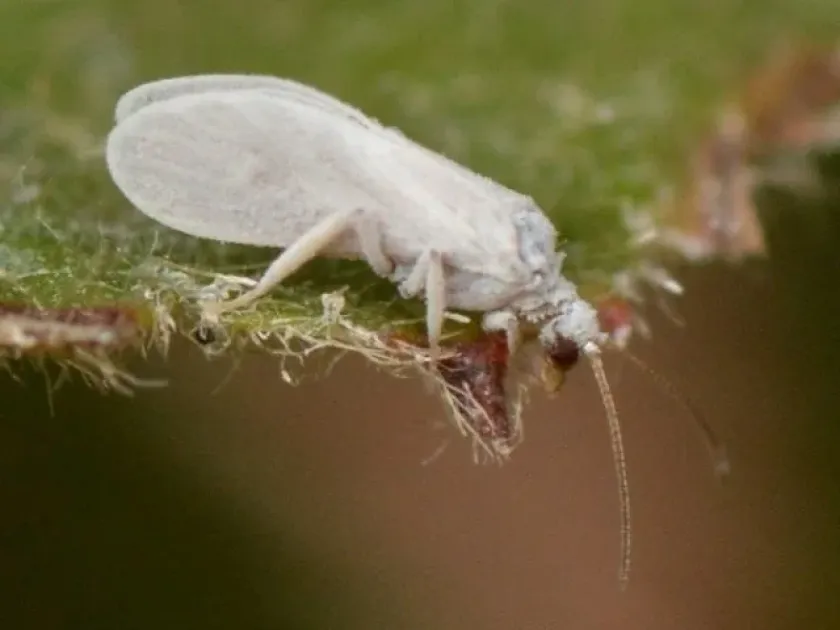
The Frosty whitefly (Aleyrodes pruinosus) belongs to the family Aleyrodidae. Its common name is derived from the appearance of the adult insects, which are covered in a fine, powdery wax that looks like white frost.
Adults are tiny insects, typically measuring 1.5–2 mm in length. They have four wings folded flat over their backs. The nymphs are scale-like, oval-shaped, and usually pale yellow or green, often found fixed to the underside of leaves.
The life cycle progresses through egg, three larval instars, puparium, and adult stages. This species is highly prolific, and development is heavily influenced by ambient temperature and relative humidity.
These pests prefer sheltered environments, which makes greenhouses and high tunnels ideal for their reproduction. They are capable of continuous breeding in warm climates throughout the year.
Proper identification is essential as they are often confused with other whitefly species. Taxonomic identification usually requires examination of the pupal characteristics under a microscope.
What it damages
The Frosty whitefly is a polyphagous pest, meaning it feeds on a wide range of plants. It is particularly notorious for damaging vegetable crops such as tomatoes, peppers, and cucumbers.
The damage is caused primarily by the nymphs and adults sucking sap from the phloem. This deprives the plant of essential nutrients, leading to stunted growth, wilting, and poor fruit development.
A secondary but equally damaging effect is the excretion of honeydew. This sticky substance encourages the growth of sooty mold (black fungi), which inhibits photosynthesis by coating the leaves.
Frosty whitefly infestation can lead to the transmission of various plant viruses. Even small populations can significantly reduce crop yields and lower the aesthetic value of ornamental plants.
Severe infestations often cause chlorosis, where leaves turn yellow or develop mottled patterns. In extreme cases, the stress can cause premature leaf drop and the death of the entire plant.
When it appears
The pest is most active during the warmer months of the year. In open fields, activity begins in late spring and continues until the onset of cold weather in autumn.
Greenhouse environments allow the Frosty whitefly to remain active and reproduce year-round, as the temperature is kept within the optimal range for their life cycle.
Population density typically peaks in mid-to-late summer. High humidity and temperatures between 22°C and 28°C create the most favorable conditions for rapid population growth.
As the days shorten and temperatures drop, whiteflies look for protected environments. Winter management is critical to prevent the population from carrying over to the next season.
Monitoring should be proactive. Starting in early spring, scouts should check for the presence of adults on the undersides of leaves and use diagnostic tools to track population trends.
Signs of infestation
The most recognizable sign is the presence of white adults that fly off in a cloud when the plant foliage is disturbed or shaken, indicating a potentially high population density.
Sticky residue on the leaves (honeydew) is a telltale sign of heavy feeding. This substance attracts ants and serves as a medium for the growth of unsightly black sooty mold.
The presence of empty pupal cases on the underside of leaves is a clear indicator that the whitefly is completing its life cycle successfully within your crop canopy.
Leaf yellowing and curling are common physiological symptoms. If the plant looks sickly, wilted, or shows poor growth despite adequate watering, a whitefly infestation should be suspected.
In cases of severe infestation, the stunted growth of terminal shoots and the deformation of young leaves provide visible evidence of the physical stress caused by the pest.
Control measures
Managing the Frosty whitefly requires an Integrated Pest Management (IPM) approach. Relying on a single method is rarely sufficient, especially in high-pressure environments.
Biological control using parasitoids such as Encarsia formosa or predatory mites is highly effective in greenhouse settings when populations are kept under control.
Chemical control should involve the use of insecticides specifically labeled for whitefly management. It is vital to rotate modes of action to prevent the development of resistant populations.
Yellow sticky traps are indispensable tools. They function both as monitoring devices to detect early arrivals and as a physical control method to capture adults before they reproduce.
- Maintain high sanitation standards by removing crop debris immediately after harvest.
- Control weeds in and around the greenhouse to eliminate alternative hosts.
- Ensure optimal airflow to regulate humidity and decrease the success of fungal growth.
- Inspect all incoming nursery stock for signs of infestation before introduction.
- Use reflective mulches in some settings to deter adults from settling on plants.
Taxonomy
- Latin name
- Aleyrodes pruinosus
- Order
- Hemiptera (bugs, aphids, leafhoppers)
- Family
- Aleyrodidae
- EPPO code
- ALEUPU
Discussion
No discussions yet — be the first.