
Honeysuckle whitefly
Aleyrodes lonicerae
Description
How to identify
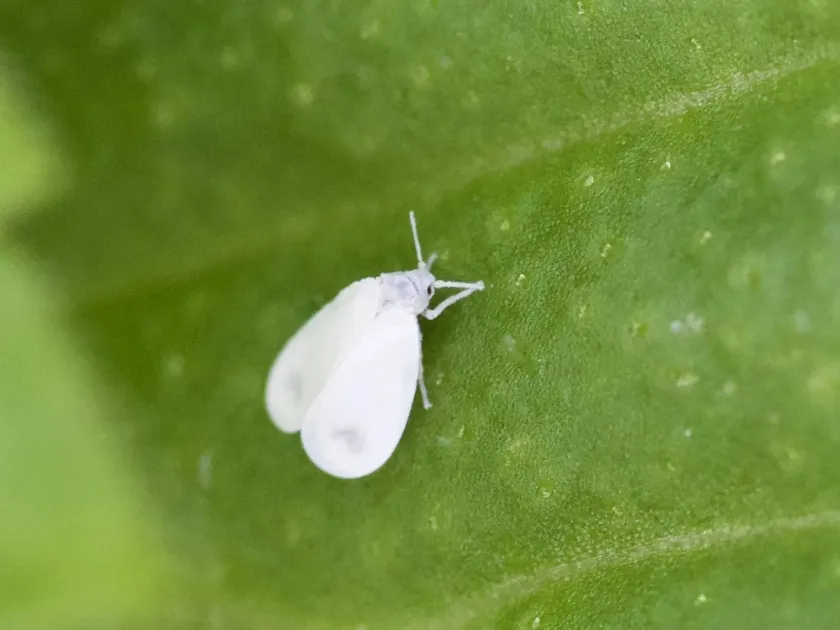
The honeysuckle whitefly (Aleyrodes lonicerae) is a small insect belonging to the family Aleyrodidae. Adult specimens measure approximately 2–3 mm in wingspan and are covered in a fine, powdery wax.
The insects have a pale, yellowish body and pure white wings, often appearing like tiny moths. When at rest, their wings are held flat against the back, which is a key identifying feature.
The immature stages, or nymphs, are scale-like and sedentary. They firmly attach themselves to the undersides of leaves, making them difficult to notice without careful inspection.
This species is highly host-specific, primarily targeting plants within the Caprifoliaceae family. Distinguishing them from other whitefly species often requires microscopic examination of the pupal case structure.
Gardeners should focus their surveillance on the lower leaf surface, as this is where the entire life cycle, excluding the adult stage, typically takes place.
What it damages
The honeysuckle whitefly mainly infests various species of honeysuckle. Like other sap-sucking pests, it draws nutrients directly from the leaf tissues, leading to plant stress.
Feeding results in chlorosis and yellow spotting on the leaves. Severe infestations often cause leaf curling, premature yellowing, and eventual leaf drop, which weakens the host plant.
A significant issue caused by this pest is the excretion of honeydew. This sticky substance encourages the growth of sooty mold, which blocks sunlight and interferes with photosynthesis.
Repeated infestations reduce the plant's overall vigor and winter hardiness. This makes the bushes more susceptible to secondary pathogens and leads to a noticeable decline in berry yields.
- Lonicera species
- Symphoricarpos
- Various ornamental shrubs
- Forest edge woody plants
When it appears
The life cycle is temperature-dependent. Adults emerge in spring when temperatures rise, beginning the cycle of egg-laying on the undersides of young, expanding leaves.
The species can complete several generations throughout the growing season. Warm, humid summers provide optimal conditions for explosive population growth, often peaking by mid-summer.
As autumn approaches and temperatures drop, the whitefly enters a dormant state. Overwintering typically occurs in the nymph or pupal stage, hidden within bark crevices or leaf litter.
Regular monitoring should start early in the spring, specifically during the budding phase, to catch the first generation before they establish a large, multi-generational colony.
Understanding the synchronization of the whitefly life cycle with the plant's phenology is critical for choosing the optimal timing for any intervention strategies.
Signs of infestation
A tell-tale sign of honeysuckle whitefly infestation is the sudden appearance of a small, white cloud of insects rising from the foliage when a branch is shaken or touched.
The presence of a sticky, shiny layer (honeydew) on the leaves is a major indicator. This often becomes blackened as sooty mold colonizes the sugary secretions of the insect.
Leaves on new shoots may appear distorted or stunted. If inspected closely, one will see many tiny, translucent scales fixed firmly along the leaf veins and margins.
The presence of empty pupal cases, which look like tiny white transparent shells on the underside of leaves, confirms that the insects have already reached the adult stage.
General yellowing of the foliage and reduced terminal growth, despite adequate watering and fertilization, are classic symptoms of sustained sap-sucking damage by these colonies.
Control measures
Cultural control is essential; regular pruning to maintain open, airy crowns helps reduce the humidity levels that favor whitefly survival and multiplication.
Sanitation practices such as raking and destroying fallen leaves during late autumn help remove the primary sites where the insects hibernate, thus lowering the spring population.
Biological control, using predatory insects or entomopathogenic fungi, serves as an effective, eco-friendly way to suppress whitefly numbers without harming the broader ecosystem.
When biological methods are insufficient, systemic insecticides may be used. Always ensure compliance with harvest intervals to protect the safety of the fruit and beneficial pollinators.
Yellow sticky traps are invaluable for both population management and monitoring. Placing them near vulnerable plants allows gardeners to detect infestations early and reduce adult numbers.
Taxonomy
- Latin name
- Aleyrodes lonicerae
- Order
- Hemiptera (bugs, aphids, leafhoppers)
- Family
- Aleyrodidae
- EPPO code
- ALEUFA
Discussion
No discussions yet — be the first.