
Fern whitefly
Aleurotulus nephrolepidis
Description
How to identify
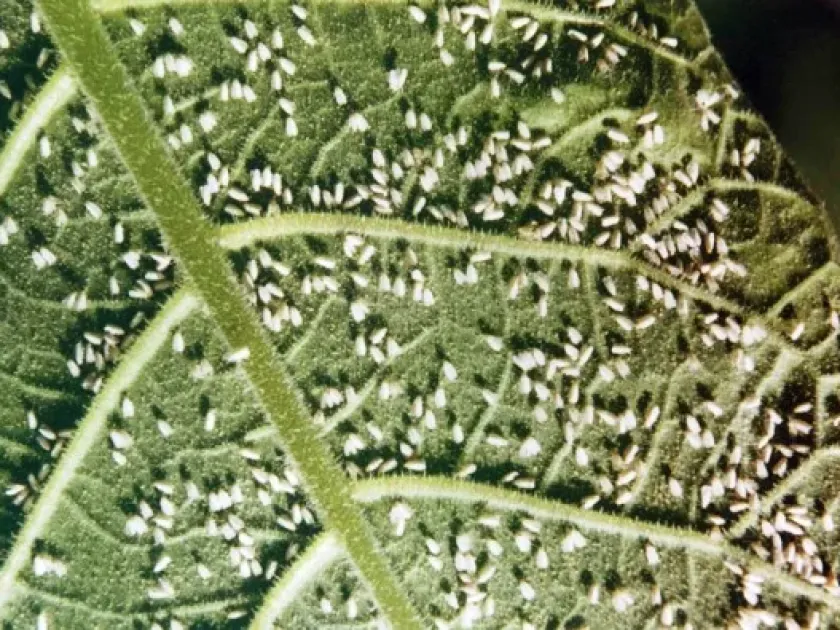
The fern whitefly is a small insect belonging to the family Aleyrodidae. Adult insects are typically about 1.5–2 mm long, featuring white wings and a body covered in a powdery, waxy secretion that provides natural protection.
These pests are highly cryptic, usually residing on the undersides of fern fronds. Their coloration and waxy coating often allow them to blend in with the spores or plant surface, making early detection challenging.
The larval stages look like flat, immobile, oval-shaped scales. As they reach the pupal stage, they fix themselves firmly to the leaf surface, appearing as small, greenish or yellowish structures.
The life cycle progresses through eggs, four larval instars, and the adult stage. Eggs are often laid in circular or crescent patterns on the undersides of young, tender fern leaves.
As a specialist pest, this species thrives in sheltered environments such as greenhouses, conservatories, and homes where humidity remains consistently high and temperatures are moderate.
What it damages
The primary hosts are various species of ferns, especially Nephrolepis. In greenhouse settings, the whitefly may occasionally spread to other decorative foliage plants sharing the same environment.
Both adults and larvae feed on plant sap. By piercing the leaf tissue with their specialized mouthparts, they drain the vital nutrients needed for the plant's metabolic processes and growth.
The most severe damage occurs at the growth tips and newly developing fronds. Feeding often leads to yellowing, distortion, curling, and the eventual death of the young plant tissue.
Heavy infestations significantly reduce the plant's aesthetic value and overall vigor. The withdrawal of sap causes the fern to lose its turgidity, leading to stunted development and leaf drop.
Furthermore, these insects can act as vectors for various plant viruses. Once a plant is weakened by sap-sucking, it becomes highly susceptible to secondary pathogens and physiological stress.
Signs of infestation
The most obvious sign of an infestation is the sudden flight of a cloud of tiny, white, moth-like insects when the fern is disturbed or shaken.
Presence of honeydew is a common indicator. This is a sticky, sweet substance excreted by the whiteflies that accumulates on the upper surfaces of leaves positioned below the infestation site.
Sooty mold growth is a frequent secondary symptom. The honeydew acts as a substrate for fungi, which covers the leaves in a black, powdery coating that blocks sunlight and inhibits photosynthesis.
Physical symptoms include chlorosis (yellowing) of the fronds, where the leaves lose their deep green color and develop irregular mottled patterns due to feeding sites.
A close inspection of the leaf undersides reveals colonies of small, static, scale-like larvae. Their presence, combined with the stickiness of the foliage, confirms an active whitefly infestation.
Control measures
Initial management should focus on isolating the infested plant. Physically removing insects by washing the fronds under a gentle stream of lukewarm water can help reduce the immediate population.
Yellow sticky traps are highly effective for monitoring and controlling the adult population, as the flies are naturally attracted to the bright yellow color of the boards.
Systemic insecticides are generally the most successful control method. Because the larvae are protected by wax, systemic products that move through the plant sap are far more effective than topical contact sprays.
Maintaining good airflow and proper plant spacing is essential to reduce humidity levels around the foliage, making the environment less hospitable for whitefly breeding cycles.
- Regular pruning of heavily infested or severely damaged fronds.
- Introduction of biological control agents like Encarsia formosa.
- Use of neem oil or insecticidal soaps as a preventive measure.
- Regular monitoring of new foliage and quarantine of new plant additions.
Taxonomy
- Latin name
- Aleurotulus nephrolepidis
- Order
- Hemiptera (bugs, aphids, leafhoppers)
- Family
- Aleyrodidae
- EPPO code
- ALELNE
Discussion
No discussions yet — be the first.