
Anthurium whitefly
Aleurotulus anthuricola
Description
How to identify
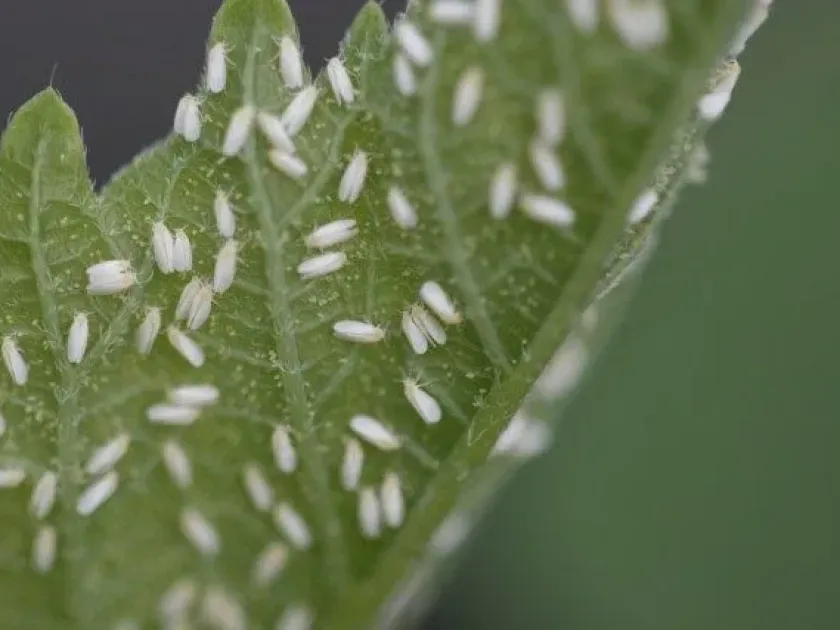
The Anthurium whitefly (Aleurotulus anthuricola) is a small pest belonging to the family Aleyrodidae, order Hemiptera. Adult insects look like tiny white moths, measuring approximately 1-2 mm in length.
Their bodies and wings are covered with a fine waxy powder, which provides a level of natural protection against moisture and some contact-based pesticides. The larvae are often pale, translucent, and immobile as they firmly attach to the plant surface.
To identify this pest, gently shake the affected plant. The adults will immediately take flight in short, fluttering bursts, creating a cloud of white particles around the foliage.
These pests usually concentrate on the underside of leaves. The colony includes eggs, larvae in various developmental stages, and adults, making the population very difficult to eradicate in one go.
The life cycle is heavily influenced by environmental conditions; higher temperatures in greenhouses or homes significantly accelerate their development, leading to overlapping generations throughout the year.
What it damages
As the name suggests, the Anthurium whitefly primarily attacks the Anthurium genus. The thick, waxy leaves of these plants provide an ideal habitat for the larvae to feed and settle.
While Anthuriums are the main target, the pest can occasionally infest other Araceae family members, especially when plants are kept in close proximity in greenhouses or interior plantscapes.
The damage is caused by the sucking mouthparts of both larvae and adults, which extract vital plant cell sap. This process saps the plant's energy and disrupts its natural physiological processes.
Severe infestations can lead to stunted growth, leaf yellowing, and in extreme cases, the total decline of the plant. If left untreated, the damage can become permanent and irreversible.
Furthermore, these insects are known vectors for various plant viruses. Introducing an infected plant to a collection can lead to the transmission of diseases that are far more lethal than the insects themselves.
Signs of infestation
Initial signs of an infestation include small, yellowish spots appearing on the upper surface of the leaves, corresponding to the feeding sites located on the underside.
A major indicator is the presence of honeydew, a sticky substance excreted by the whiteflies. This residue quickly becomes a substrate for sooty mold, which appears as a black, dusty coating.
Sooty mold blocks sunlight from reaching the leaf surface, significantly reducing the plant's ability to photosynthesize. This leads to weakened growth and a dull, unhealthy appearance.
Upon closer inspection with a magnifying glass, you may notice tiny translucent scales (puparia) or small egg clusters on the lower leaf surface, often arranged in circular or random patterns.
- Chlorotic spots on leaves.
- Sticky honeydew residue on foliage.
- Development of black sooty mold.
- Deformed or curling new leaf growth.
- Presence of tiny white flying insects.
Control measures
Managing the Anthurium whitefly requires a systematic and persistent approach. Because the eggs and pupae are often resistant to contact sprays, multiple applications are strictly necessary.
Systemic insecticides are the most effective method for control. These are absorbed by the plant and ensure that when the whiteflies feed on the sap, they ingest the toxic compound.
Regular monitoring using yellow sticky traps is highly recommended. These traps do not eliminate the entire population but serve as an early warning system to track the insects' activity.
Mechanical cleaning, such as washing the leaves with a mild soapy solution, helps to remove the sticky honeydew and many larvae, effectively slowing down the spread of the pest.
Isolation and quarantine of new plants for at least 2-3 weeks before introducing them into your main collection is the best preventative strategy against establishing an infestation.
Taxonomy
- Latin name
- Aleurotulus anthuricola
- Order
- Hemiptera (bugs, aphids, leafhoppers)
- Family
- Aleyrodidae
- EPPO code
- ALELAN
Discussion
No discussions yet — be the first.