
Aleurotuba
Aleurotuba
Description
How to identify
Aleurotuba is a genus belonging to the family Aleyrodidae, commonly known as whiteflies, within the order Hemiptera. These insects are characterized by their small, moth-like appearance with wings covered in a fine, powdery wax.
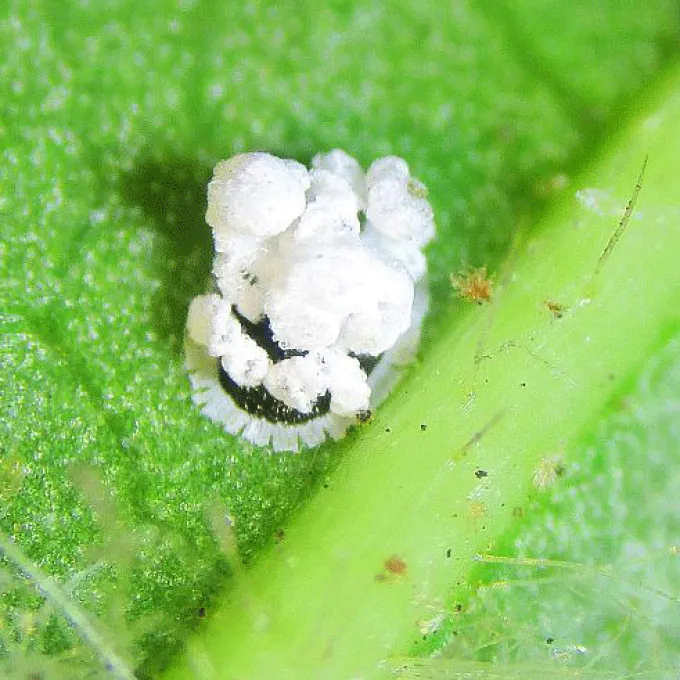
The immature stages, specifically the puparia, are flat, oval-shaped, and usually found on the underside of leaves. Due to their coloration, they often blend in with the leaf surface, making detection challenging.
Taxonomic identification of these insects typically requires examination of the vasiform orifice and specific dorsal setae on the puparium under high-magnification microscopy.
The life cycle encompasses several distinct stages: egg, three larval instars, puparium, and adult. This hemimetabolous development allows the insect to adapt to various environmental conditions.
Warm and humid environments are conducive to their proliferation, which is why infestations are frequently observed in sheltered gardens or greenhouse conditions.
What it damages
The primary host for the well-known species Aleurotuba jelinekii is the Laurustinus (Viburnum tinus), a common ornamental shrub in many landscapes.
By piercing the leaf tissue with their specialized mouthparts, both larvae and adults extract sap, which deprives the plant of essential nutrients and fluids.
The feeding process results in the excretion of honeydew, a sugary substance that coats the leaves and serves as a medium for sooty mold fungi to grow.
Severe infestations lead to chlorosis, leaf curl, and premature senescence, significantly reducing the vigor and aesthetic value of the affected host plants.
Continued sap-sucking pressure can cause stunted growth of young shoots and may lead to branch dieback if the infestation remains unmanaged for several seasons.
Signs of infestation
One of the earliest signs is the presence of white, powdery, or waxy residues on the undersides of leaves, accompanied by the appearance of flying adults when the plant is disturbed.
The development of a black, velvet-like layer (sooty mold) on leaves indicates the presence of honeydew-secreting insects such as Aleurotuba.
Visible yellowing or mottled patterns on leaves, combined with signs of general stress, often point to a sap-sucking pest infestation in progress.
A closer inspection with a magnifying glass reveals small, sessile, oval-shaped puparia stuck firmly to the abaxial leaf surface.
In cases of heavy infestation, a noticeable sticky texture on the upper leaves of lower branches is a reliable indicator that the colony has reached a high density.
Control measures
Cultural control involves pruning and disposing of heavily infested branches to reduce the initial pest population and improve air circulation within the plant canopy.
Yellow sticky traps are a highly effective monitoring tool that also helps reduce the number of adult whiteflies in the immediate area.
Chemical control options include systemic insecticides, which are absorbed by the plant and provide a prolonged effect against sap-feeding insects.
Biological control agents, such as parasitoid wasps of the genus Encarsia, can be utilized to naturally regulate the population density of the pest.
Regular scouting of vulnerable shrubs is crucial; early detection allows for physical removal or soft chemical treatments, minimizing the impact on the ecosystem.
Taxonomy
- Latin name
- Aleurotuba
- Order
- Hemiptera (bugs, aphids, leafhoppers)
- Family
- Aleyrodidae
- EPPO code
- ALTUSP
Discussion
No discussions yet — be the first.