
Ishigaki whitefly
Aleurotrachelus ishigakiensis
Description
How to identify
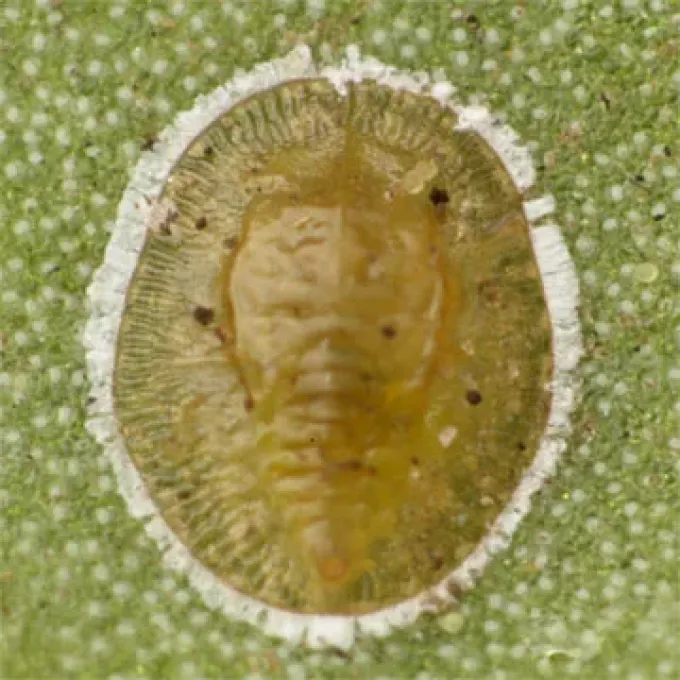
The Ishigaki whitefly (Aleurotrachelus ishigakiensis) belongs to the order Hemiptera and the family Aleyrodidae. It is a small insect characterized by specific morphological features in its pupal stage.
Adult insects have two pairs of wings covered in a white, waxy, powdery secretion, which is a diagnostic feature of whiteflies. The body of the adult is usually pale yellow or light orange, measuring approximately 1–1.5 mm in length.
First-instar larvae, known as crawlers, are mobile and move across the leaf surface to locate suitable feeding sites. Once they establish a feeding position, subsequent larval instars become sessile and fixed to the leaf.
The pupae are dark, often black or dark brown, making them easily distinguishable from other whitefly species when observing the underside of leaves with a magnifying glass.
The lifecycle follows incomplete metamorphosis, consisting of the egg stage, several larval instars, the pupal stage, and the adult stage.
What it damages
The primary hosts of this pest are citrus plants, including mandarins, lemons, and oranges. In some cases, it can also infest various ornamental plants found in residential or orchard environments.
Both adults and nymphs cause damage by extracting sap from plant tissues, which weakens the host plant and reduces its overall photosynthetic capacity.
High levels of infestation lead to yellowing, leaf drop, and stunted growth of young shoots. This stress significantly affects the development and physiological health of the tree.
Whiteflies excrete honeydew, a sugary substance that promotes the growth of sooty mold. This mold covers the surface of leaves and fruit, interfering with respiration and lowering the market value of the produce.
In commercial orchards, significant economic loss can occur if infestations are not managed properly, leading to reduced yield and poor fruit quality.
When it appears
The activity and population dynamics of the Ishigaki whitefly are highly dependent on environmental conditions, particularly temperature and humidity, which favor rapid development.
In tropical and subtropical regions, or in greenhouse conditions, the pest can reproduce continuously throughout the year, with overlapping generations making control more complex.
Dispersal is achieved through wind currents and the movement of infested plant material. Trade in nursery stock is a primary pathway for the introduction of this pest to new areas.
The pest typically survives adverse conditions by overwintering as pupae on the underside of evergreen leaves, which provide shelter and sustenance.
The most critical period for observation is during the spring and summer flush, when young, succulent foliage is available for colonization.
Signs of infestation
An initial indicator of infestation is the presence of small, moth-like adults that fly up in clouds when the branches of a tree are disturbed or shaken.
A closer inspection of the undersides of leaves reveals the presence of settled nymphs and the distinctive dark-colored pupae, which are firm and clearly visible.
The accumulation of sticky honeydew on the foliage and the subsequent development of black sooty mold are clear signs of a severe or long-standing infestation.
Plant foliage may show symptoms of chlorosis, curling, or distortion as the pest continues to feed. Premature leaf drop is a common symptom in heavy infestations.
Reduced tree vigor, slowed growth of new buds, and poor fruit development are physiological signs that the tree is suffering from the impact of the pest.
Control measures
Integrated Pest Management (IPM) strategies for the Ishigaki whitefly include strict phytosanitary measures to prevent the spread of the pest through plant transport.
Cultural control involves maintaining proper tree canopy structure through pruning to improve ventilation and light penetration, which discourages whitefly colonization.
Chemical control is effective when systemic insecticides are used during the peak periods of insect activity. It is crucial to rotate chemical classes to prevent the development of resistance.
Biological control focuses on utilizing natural enemies, such as parasitoid wasps and predatory mites, which can keep populations below economic damage thresholds.
- Regular monitoring using yellow sticky traps.
- Manual removal of heavily infested leaves or shoots.
- Application of horticultural oils to manage larval populations.
- Promotion of beneficial insect populations in the orchard.
Taxonomy
- Latin name
- Aleurotrachelus ishigakiensis
- Order
- Hemiptera (bugs, aphids, leafhoppers)
- Family
- Aleyrodidae
- EPPO code
- TRIAIS
Discussion
No discussions yet — be the first.