
Cacao whitefly
Aleurotrachelus cacaorum
Description
How to identify
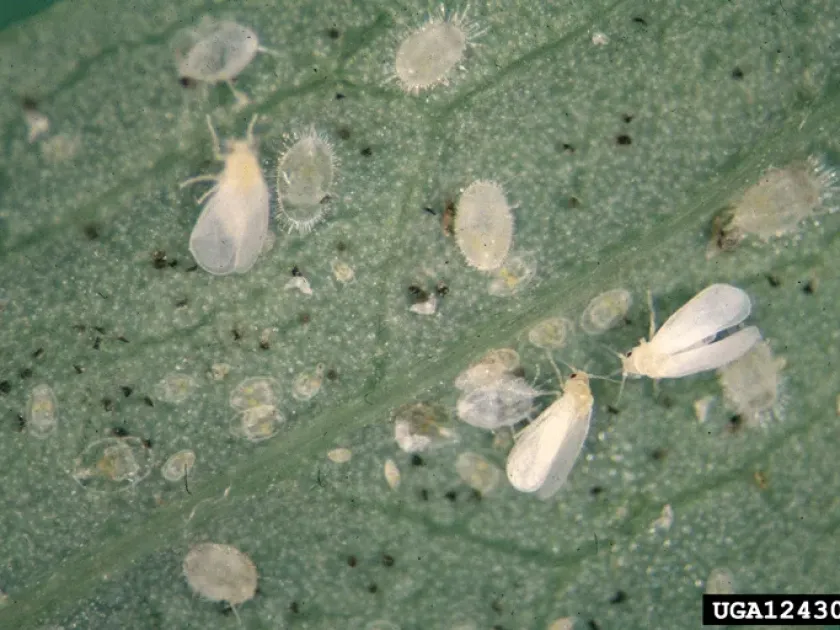
The cacao whitefly (Aleurotrachelus cacaorum) is a member of the Aleyrodidae family. It is a small insect characterized by wings covered with a white waxy powder.
Adults are tiny, moth-like insects that gather on the undersides of leaves. Their lifecycle progresses through egg, larval stages, a pupal stage, and the adult phase.
The pupal stage is sedentary and often appears as a flat, dark, or translucent scale-like structure attached to the foliage.
Proper identification often requires microscopic examination of the pupal characteristics, such as the shape and the presence of specific setae.
They thrive in warm, humid tropical environments where cacao trees are typically cultivated, allowing for continuous generations throughout the year.
What it damages
The primary host for this pest is the cacao tree (Theobroma cacao). The nymphs and adults extract sap from the leaves, causing nutrient depletion.
The feeding process significantly stresses the plant, leading to stunted growth, leaf chlorosis, and, in severe cases, premature leaf drop.
By weakening the host plant, the whitefly makes the cacao tree more susceptible to secondary infections, including fungal pathogens.
The reduction in the plant's photosynthetic capacity directly affects the quality and quantity of the cacao bean harvest.
In high-density populations, the cumulative damage can lead to branch dieback and, in young trees, may cause significant physiological decline.
Signs of infestation
The most evident sign is the presence of honeydew on the leaves, which makes the foliage appear sticky and shiny to the naked eye.
Sooty mold frequently colonizes the honeydew, manifesting as a thick black coating on the leaves and sometimes the stems of the tree.
Small, scale-like pupae can be found clustered on the undersides of leaves, often near the primary veins where sap flow is most concentrated.
Yellowing of the leaves is a common symptom as the plant loses vital nutrients and energy required for healthy physiological function.
Ant activity on the tree is a strong indicator of whitefly presence, as ants are often attracted to the sweet honeydew secretions.
Control measures
Integrated Pest Management (IPM) is essential for controlling the cacao whitefly, combining cultural, biological, and chemical strategies.
Improving orchard ventilation through pruning is a crucial cultural practice that creates an environment less favorable for whitefly development.
Biological control involves encouraging natural predators and parasitoids that feed on whitefly nymphs, providing long-term suppression.
Chemical control should be applied using systemic insecticides during the peak of adult emergence to effectively interrupt the life cycle.
- Installation of yellow sticky traps for monitoring populations.
- Regular inspection of young nursery seedlings.
- Destruction of heavily infested plant materials.
- Selective use of horticultural oils for non-toxic pest suppression.
Taxonomy
- Latin name
- Aleurotrachelus cacaorum
- Order
- Hemiptera (bugs, aphids, leafhoppers)
- Family
- Aleyrodidae
- EPPO code
- ALTRCA
Discussion
No discussions yet — be the first.