
Palm whitefly
Aleurotrachelus atratus
Description
How to identify
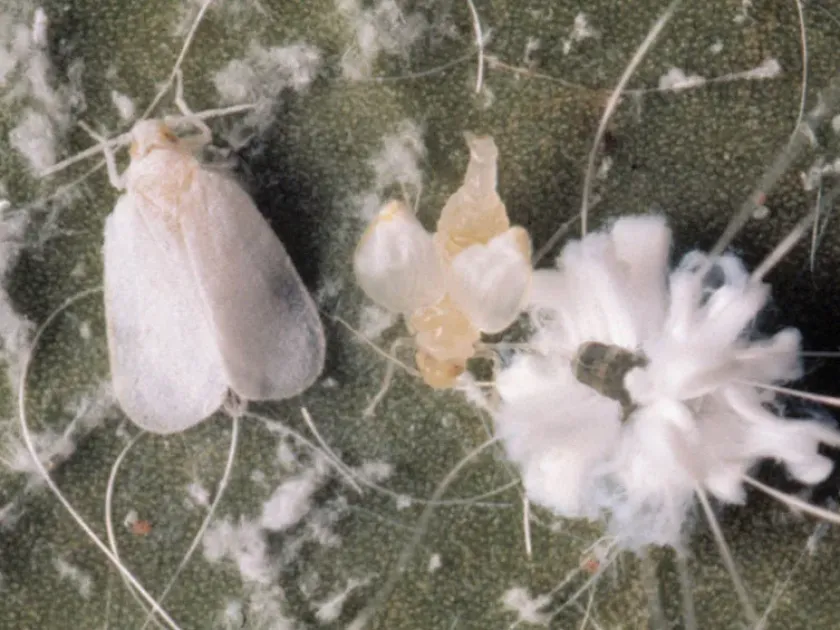
The palm whitefly (Aleurotrachelus atratus) belongs to the Hemiptera order and the Aleyrodidae family. It is a small insect characterized by a yellowish body covered with a powdery white wax, which gives it its common name.
The immature stages, or nymphs, are typically sedentary, oval-shaped, and often dark in color, making them look like small black scales attached to the underside of the leaf.
The life cycle consists of the egg, several larval instars, and the adult stage. In warm climates or indoor environments, these insects can breed year-round, resulting in overlapping generations.
Females prefer laying eggs on the abaxial (lower) surface of leaves, which protects the developing nymphs from predators and drying out due to wind or sun exposure.
Identification is easiest by inspecting the undersides of the leaves, where the colony is most active, especially on older foliage where nymphs tend to cluster.
What it damages
The palm whitefly primarily attacks various species of palms (Arecaceae), making it a significant nuisance for both ornamental landscaping and greenhouse production.
By feeding on the plant's phloem, these insects extract vital sap, which stresses the host plant and can lead to stunted growth and reduced vigor in heavily infested palms.
The physical damage caused by feeding can lead to leaf yellowing and curling, which severely diminishes the aesthetic value of ornamental palm species.
A secondary problem is the accumulation of honeydew, a sugary excretion produced by the larvae, which serves as a substrate for sooty mold growth.
Sooty mold coats the leaves, effectively blocking sunlight and significantly impairing the plant's ability to perform photosynthesis, ultimately threatening the palm's survival.
Signs of infestation
The most immediate sign of an infestation is the presence of sticky honeydew on the leaves, which often attracts ants and makes the plant surface feel tacky.
A thick, black, powdery substance known as sooty mold will soon follow, covering the leaves and reducing the plant's ability to absorb light.
Careful inspection of the lower leaf surfaces will reveal numerous sedentary nymphs, which appear as small, dark, flattened spots attached to the plant tissue.
Disturbing the palm foliage often triggers an immediate reaction, with adults taking flight in a visible cloud, confirming a well-established colony.
Gradual leaf drop, general wilting, and a loss of green pigment are telltale signs that the whitefly population has reached a damaging level.
Control measures
Effective management of palm whitefly requires an integrated pest management (IPM) strategy that combines cultural, biological, and chemical control methods.
Quarantine and strict inspection of new plant materials are essential steps to prevent the introduction of this pest into greenhouses or interior gardens.
Biological control can be highly effective, as the introduction of specific parasitic wasps can help keep the whitefly population below the economic threshold.
Chemical control should be directed at the nymphs using systemic insecticides that are absorbed into the plant vascular system, providing lasting protection.
- Regularly washing leaves with water to remove honeydew and physical debris.
- Deploying yellow sticky traps to capture and monitor adult whitefly populations.
- Pruning and destroying heavily infested leaves to reduce the source of the infestation.
- Using horticultural oils or systemic insecticides applied according to local guidelines.
Taxonomy
- Latin name
- Aleurotrachelus atratus
- Order
- Hemiptera (bugs, aphids, leafhoppers)
- Family
- Aleyrodidae
- EPPO code
- ALTRAT
Discussion
No discussions yet — be the first.