
Citrus whitefly
Aleurothrixus porteri
Description
How to identify
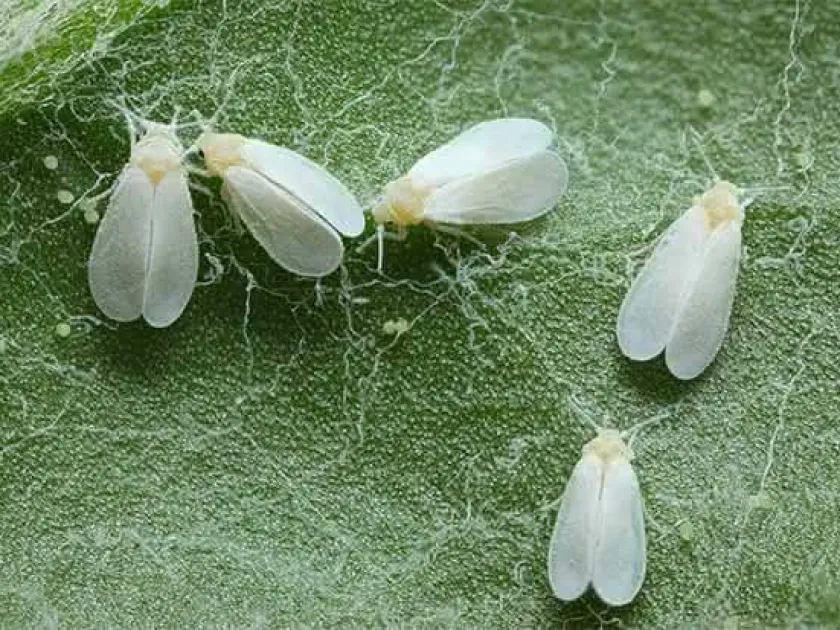
The Citrus whitefly (Aleurothrixus porteri) is a small insect belonging to the family Aleyrodidae. Adult insects are characterized by white, powdery-looking wings, which are coated in a fine waxy secretion.
The larvae progress through several developmental stages, eventually becoming sessile (stationary) and flattened on the leaf surface. They appear as small, translucent discs with distinct marginal filaments.
A key identification feature is the presence of waxy filaments produced by the larvae. These filaments often mat together, creating a protective enclosure around the infestation site on the underside of leaves.
Due to their tiny size, these insects are often overlooked until a significant population is established. Using a hand lens is recommended to inspect the underside of leaves for these characteristic waxy structures.
Differentiation from other whitefly species is typically based on the morphology of the pupal case, as the adult forms share similar general appearances with many other members of the Aleyrodidae family.
What it damages
This pest primarily infests plants in the Rutaceae family, with a strong preference for citrus species such as lemons, oranges, mandarins, and grapefruits grown in orchards or gardens.
The damage is caused primarily by the nymphs, which pierce the leaf tissue to feed on sap. This process saps the plant's vitality, leading to reduced growth rates and overall stress.
A major indirect threat is the production of honeydew. This sugary substance accumulates on the foliage and serves as a medium for the growth of sooty mold, a fungus that manifests as black patches.
The sooty mold layer severely inhibits photosynthesis by blocking light from reaching the leaf surface, which can eventually lead to premature leaf drop and tree decline.
Heavy infestations not only ruin the cosmetic appearance of the tree but also significantly impair the tree's ability to produce high-quality fruit, resulting in economic losses for growers.
When it appears
Citrus whitefly development is highly dependent on environmental conditions, with warm and humid climates being the most conducive for rapid reproduction and population growth.
In optimal conditions, the life cycle is quite short, allowing for multiple overlapping generations throughout the growing season, which leads to exponential population increases if left unchecked.
Greenhouse environments provide a year-round breeding ground for the Citrus whitefly, as the stable, warm temperatures prevent the seasonal dormancy that might otherwise occur outdoors.
In outdoor settings, peak activity typically correlates with late summer and early autumn when humidity levels rise and foliage is dense, offering both food and protection to the colony.
Adult whiteflies are capable of short flights and are often dispersed by wind currents, which facilitates the rapid colonization of adjacent host plants within a localized orchard area.
Signs of infestation
The most visible sign of an infestation is the presence of white, powdery masses on the underside of leaves, which will immediately disperse into the air if the branch is disturbed.
The appearance of black, sooty mold covering the upper side of the leaves is a classic symptom that suggests the presence of sap-sucking insects like the Citrus whitefly.
Stunted growth of new shoots and the curling of leaves are strong indicators that the plant is suffering from chronic nutritional depletion due to the larval feeding process.
Increased ant traffic on the branches is often observed, as ants are attracted to the honeydew excreted by the whitefly nymphs during their development.
Visible yellowing of foliage or localized chlorosis around feeding sites indicates a severe infestation that requires immediate attention and intervention to prevent tree health deterioration.
Control measures
Effective management begins with routine monitoring and the physical removal of heavily infested twigs or branches, which helps to immediately lower the pest population density.
Yellow sticky traps are highly effective for monitoring the presence and activity of adult whiteflies, helping growers determine the optimal timing for further control measures.
Systemic insecticides are frequently used to control whitefly infestations, as they are absorbed into the plant's vascular system and eliminate nymphs that feed on the sap.
Biological control, using natural predators or parasitoids like certain species of Encarisa wasps, can be very effective in reducing populations within integrated pest management programs.
Washing the canopy with water jets or applying horticultural soaps can physically remove larvae and clear away the sooty mold, providing a cleaner surface for leaf respiration.
Taxonomy
- Latin name
- Aleurothrixus porteri
- Order
- Hemiptera (bugs, aphids, leafhoppers)
- Family
- Aleyrodidae
- EPPO code
- ALTHPO
Discussion
No discussions yet — be the first.