
Citrus woolly whitefly
Aleurothrixus howardi
Description
How to identify
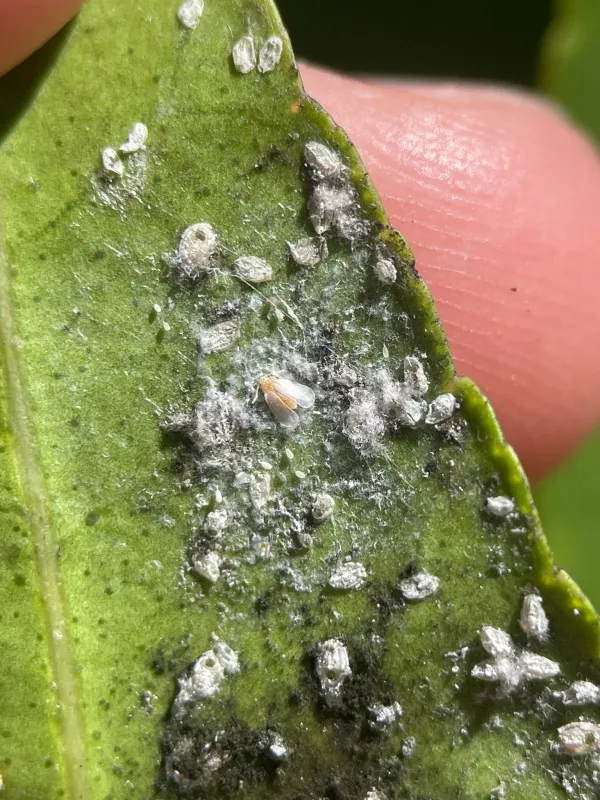
The citrus woolly whitefly (Aleurothrixus howardi) is a member of the Aleyrodidae family. Adult individuals are tiny, measuring approximately 1 to 1.5 millimeters in length, with wings covered in a powdery white wax.
The body of the adult is typically yellow, but it is heavily obscured by the waxy secretion. This whitefly species is distinguished by the physical appearance of its larvae, which produce distinct woolly or waxy filaments.
The life cycle involves an egg stage, several larval instars, a pupal stage, and an adult stage. Females lay their eggs in small circular groups on the underside of young leaves, anchored by a small pedicel.
These whiteflies thrive in warm, humid climates, allowing for overlapping generations throughout the year. This reproductive capacity makes them persistent pests in citrus-growing regions globally.
Identifying the species can be done by observing the arrangement of the waxy secretions on the larval stages, which serve as a protective barrier against many environmental stressors.
What it damages
The primary host range of this pest consists of various citrus species, including oranges, lemons, and grapefruits. It can occasionally infest other woody plants in tropical and subtropical environments.
Both larvae and adults extract plant sap by feeding on the phloem of young leaves and shoots. This feeding process results in the depletion of vital nutrients and water from the host plant.
Heavy infestations lead to leaf curling, premature yellowing, and leaf drop. Young trees are particularly susceptible to stunted growth due to the stress caused by the feeding activity.
Furthermore, the pests secrete large amounts of honeydew. This sticky substance covers the foliage and fruit, creating a perfect medium for the growth of sooty mold fungi.
The resulting sooty mold interferes with photosynthesis and leaves a dark, unsightly coating on fruit surfaces, which significantly lowers the commercial grade of the citrus harvest.
Signs of infestation
The most prominent sign of an infestation is the presence of sticky honeydew on the upper surface of leaves situated below the whitefly colonies.
On the undersides of the leaves, one can observe dense clusters of larvae surrounded by white, wool-like wax, which creates the appearance of white patches.
When infested branches are shaken, adult whiteflies rise in a conspicuous cloud before settling back onto the leaf surface, indicating a high population density.
Leaf deformation and chlorosis (yellowing) are strong indicators that the pest is actively draining resources from the tree's vascular system.
The gradual development of a black, velvet-like layer of sooty mold on leaves and twigs is a classic indicator of a long-standing citrus woolly whitefly presence.
Control measures
Biological control is the cornerstone of managing this pest. The introduction of parasitoid wasps, such as Cales noacki, has proven highly successful in reducing whitefly populations below economic damage levels.
Chemical control involving systemic insecticides is often used in commercial orchards. It is crucial to ensure thorough coverage, especially targeting the undersides of leaves where the whiteflies reside.
The application of horticultural mineral oils is effective because these oils degrade the waxy filaments of the larvae, suffocating the insects and increasing their susceptibility to environmental factors.
Cultural practices, such as pruning to open the tree canopy, improve light penetration and air circulation. This reduction in humidity makes the environment less hospitable for the whitefly larvae.
Using yellow sticky traps for population monitoring helps growers detect the arrival of adult whiteflies early, allowing for timely intervention before the pest colonizes new growth.
Taxonomy
- Latin name
- Aleurothrixus howardi
- Order
- Hemiptera (bugs, aphids, leafhoppers)
- Family
- Aleyrodidae
- EPPO code
- ALTHHO
Discussion
No discussions yet — be the first.