
Citrus whitefly
Aleurothrixus floccosus
Description
How to identify
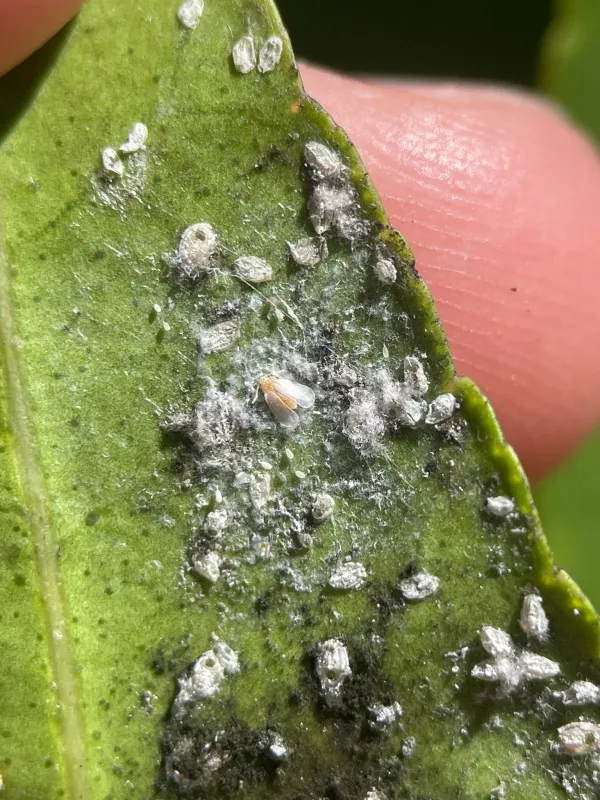
The citrus whitefly (Latin: Aleurothrixus floccosus) belongs to the order Hemiptera and the family Aleyrodidae. These small insects, measuring 1 to 1.5 mm in length, are easily recognized by their white wings covered in a fine waxy powder.
The life cycle includes an egg stage, three larval stages, a pupal stage, and the adult insect. Eggs are typically laid on the underside of young leaves, often arranged in circles or scattered clusters.
The first-instar larvae, known as "crawlers," are mobile but soon settle down to feed. As they develop, they become stationary and secrete distinctive white waxy filaments, creating a fluffy appearance on the foliage.
The rate of development is highly dependent on environmental conditions, particularly temperature and humidity. In greenhouses or tropical climates, these insects can breed throughout the year, producing multiple overlapping generations.
Unlike other whitefly species, the citrus whitefly is specifically associated with the woolly appearance of its larval colonies, which acts as a key identifier in the field.
What it damages
The citrus whitefly primarily infests members of the Rutaceae family, especially citrus crops such as lemons, oranges, and grapefruits. The damage is caused by both adults and larvae piercing the plant tissue and sucking the phloem sap.
Severe infestations lead to nutrient depletion, resulting in chlorosis, leaf curl, and premature leaf drop. The plant's overall vigor is significantly reduced, which can stunt tree growth.
A major indirect threat is the production of honeydew. This sticky substance covers the leaves and encourages the growth of sooty mold (Capnodium spp.), which creates a black film that blocks light and disrupts photosynthesis.
Fruit quality is often compromised due to the lack of nutrients and the presence of sooty mold, which requires cleaning before the fruit can be marketed.
In ornamental citrus plants, the presence of these white colonies and the resulting black mold significantly reduce the aesthetic and commercial value of the specimen.
When it appears
In outdoor orchards, the population of the citrus whitefly typically peaks during warm and humid months. These conditions are optimal for the rapid reproductive cycles of the insect.
In indoor environments such as nurseries, greenhouses, and conservatories, the whitefly remains active all year round. The controlled climate eliminates the seasonal dormancy that might occur in colder regions.
Migration between trees is most active during the day. Adults are capable of flying short distances to infest healthy leaves, and they can be easily spread through the movement of infested nursery stock.
During the spring and summer, population growth is exponential, making early intervention critical to preventing widespread outbreaks within an orchard or garden.
Winter survival is possible in temperate climates where the pest can persist on evergreen citrus foliage or in protected microclimates until the return of warmer weather.
Signs of infestation
The most noticeable sign is a cloud of small white insects flying up when the tree branches are disturbed. This is usually the first indication of an established infestation.
Inspecting the underside of the leaves will reveal the characteristic woolly white wax filaments produced by the larvae. These colonies are often dense and cover a significant portion of the leaf surface.
The presence of a sticky, glistening substance (honeydew) on the leaves below the colony is a clear diagnostic sign of whitefly activity. Over time, this substance turns into a dark, sooty coating.
Deformed or yellowing leaves, particularly in the crown of the tree, indicate that the tree is suffering from chronic nutrient loss caused by the feeding insects.
Deteriorating plant health, characterized by poor fruit set and reduced flowering, often accompanies heavy whitefly presence in neglected citrus groves.
Control measures
Effective management begins with cultural practices, such as proper pruning to improve air circulation and sunlight penetration within the canopy, which makes the environment less favorable for the whitefly.
Biological control is highly successful for this species. The introduction of the parasitoid wasp Cales noacki has been instrumental in controlling the citrus whitefly in many parts of the world by targeting the larval stages.
Chemical control involving systemic insecticides is effective during heavy outbreaks. These products are absorbed by the plant and kill the pests as they feed, providing longer-lasting protection than contact sprays.
Application of horticultural oils or insecticidal soaps can help manage smaller populations by suffocating the insects and washing away the honeydew, without leaving toxic residues.
- Monitoring populations using yellow sticky traps.
- Regular inspections of leaf undersides for early detection.
- Quarantine measures for new plant introductions to prevent spread.
- Integrated pest management (IPM) combining natural predators with targeted chemical use.
Taxonomy
- Latin name
- Aleurothrixus floccosus
- Order
- Hemiptera (bugs, aphids, leafhoppers)
- Family
- Aleyrodidae
- EPPO code
- ALTHFL
Discussion
No discussions yet — be the first.