
Taonaba whitefly
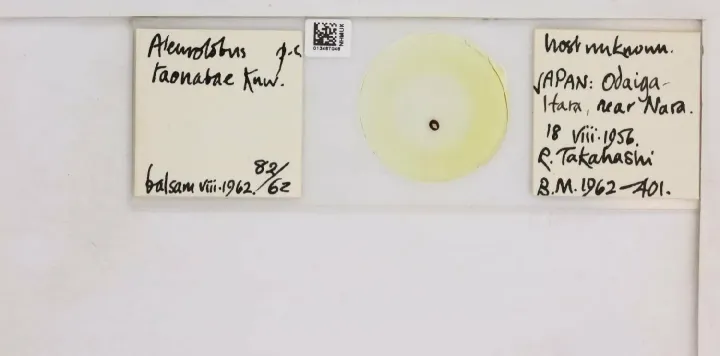
Aleurolobus taonabae
Description
How to identify
The Taonaba whitefly (Aleurolobus taonabae) is an insect species belonging to the order Hemiptera and the family Aleyrodidae. Adult specimens are small, moth-like insects with wings covered in a characteristic white waxy powder.
The nymphal stages are particularly notable; these insects attach themselves firmly to the underside of leaves and take on a flattened, scale-like appearance, which often leads to confusion with scale insects.
The life cycle progresses through several stages: egg, three larval stages, a puparial stage, and the adult stage. The puparium is the most resilient stage, serving as a protective shell during various life phases.
This species is well-adapted to warm climates, utilizing various host plants to complete its biological cycle efficiently, often resulting in multiple overlapping generations.
Due to their small size and cryptic habits, identifying the pest in the early stages of infestation is challenging, requiring close observation of the underside of leaves.
What it damages
This whitefly species targets a variety of plants, including members of the Theaceae family and other ornamental trees, causing significant stress to the host organism.
By using their piercing-sucking mouthparts, the insects feed directly on plant sap, which leads to a severe loss of nutrients and a decrease in the plant's overall vigor.
As the insects feed, they excrete honeydew, a sticky substance that promotes the growth of sooty mold, which blocks sunlight and hinders the essential process of photosynthesis.
Severe infestations manifest as chlorosis (yellowing), wilting, and the eventual abscission of leaves, significantly diminishing the plant’s health and ornamental appeal.
In nursery settings, heavy infestations can lead to stunted growth or even the mortality of young seedlings, creating economic losses for growers and gardeners alike.
When it appears
The population activity of the Taonaba whitefly is highly correlated with warm temperatures and high humidity levels, which provide optimal conditions for reproduction.
In greenhouse or indoor environments, these pests can thrive throughout the entire year, as the controlled climate prevents the seasonal decline in their biological activity.
Summer months represent the peak of infestation, as the accelerated metabolic rates allow for the rapid development of successive generations within a short period.
During colder months, the pest typically slows down its development, surviving as puparia in sheltered areas until the arrival of more favorable climatic conditions.
Effective management begins with early-season monitoring, using sticky yellow traps to detect the arrival and population density of the adult whiteflies in the field.
Signs of infestation
Key indicators of an infestation include the presence of small white flies taking flight upon leaf disturbance and the occurrence of sticky honeydew residues on the foliage.
- Yellowing of leaves, starting from the leaf margins.
- Black sooty mold growth covering the leaves.
- Small, immobile, scale-like nymphs on the leaf undersides.
- Distorted or curled new shoots and leaf tips.
- Visible clouds of white adult insects when the plant is shaken.
Control measures
Managing the Taonaba whitefly requires an integrated pest management (IPM) strategy that combines physical sanitation with targeted chemical or biological treatments.
Manual removal of infested foliage and regular washing of leaves with high-pressure water can physically displace larvae and remove sticky residues, slowing down the population growth.
For chemical control, the use of systemic insecticides, such as neonicotinoids, is highly effective, as these compounds are absorbed by the plant and kill the insects during feeding.
Biological control agents, such as parasitoid wasps (e.g., Encarsia species) or predatory mites, can be introduced in greenhouses to naturally regulate the whitefly population.
Cultural practices, such as ensuring proper plant spacing for better airflow and avoiding over-fertilization with nitrogen, are essential to minimize the risk of secondary infestations.
Taxonomy
- Latin name
- Aleurolobus taonabae
- Order
- Hemiptera (bugs, aphids, leafhoppers)
- Family
- Aleyrodidae
- EPPO code
- ALERTA
Discussion
No discussions yet — be the first.