
Olive whitefly
Aleurolobus olivinus
Description
How to identify
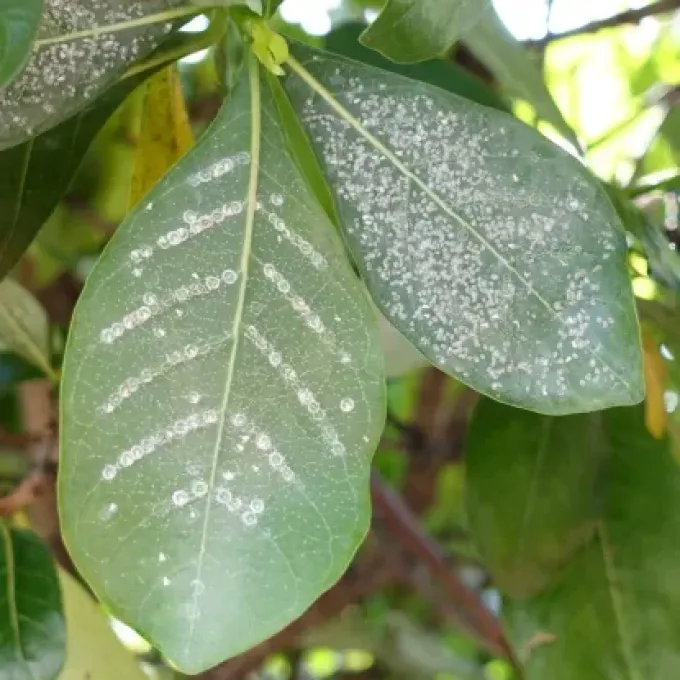
The olive whitefly (Aleurolobus olivinus) is a small hemipteran insect belonging to the Aleyrodidae family. Adult individuals are typically 1–1.5 mm long and possess wings covered in a distinctive white waxy powder.
When at rest, their wings are held in a roof-like position against the body. The nymphal stages, particularly the later ones, are sessile and appear as small, flat, dark-colored scales on the undersides of leaves.
This species is highly host-specific, primarily infesting trees of the genus Olea. Their life cycle includes an egg stage, several larval instars (including the mobile 'crawler' stage), and the pupal stage.
The pupal stage is easily recognizable due to its dark, brownish-black appearance, which distinguishes it from many other whitefly species found on different horticultural crops.
Reproduction is sexual, and the female can lay numerous eggs on the tender foliage. The development rate is heavily influenced by ambient temperature, with warmer climates favoring faster population growth.
What it damages
The olive whitefly primarily infests the olive tree (Olea europaea), causing damage by feeding on the sap of leaves. The depletion of nutrients weakens the overall vigor of the tree.
Symptoms of heavy infestation include chlorosis, leaf yellowing, and premature senescence of the foliage. This reduces the photosynthetic area, which directly impacts the tree's ability to produce high-quality fruit.
A major indirect damage is the secretion of honeydew, a sugary substance that serves as a medium for the growth of sooty mold. This black fungal layer covers the leaves, further inhibiting photosynthesis.
Young trees are particularly susceptible to severe damage. Heavy infestations can result in stunted growth, distorted shoots, and a significant reduction in the expected yield of olives.
In addition to physiological stress, the aesthetic and commercial quality of the olive crop can be compromised, as sooty mold can adhere to the fruits and twigs, complicating the harvesting process.
When it appears
The activity of the olive whitefly is highly seasonal, peaking during the spring and summer months when temperatures are optimal for larval development and adult flight.
There can be multiple generations per year depending on the geographic location. The mobile 'crawler' stage is most prevalent in mid-summer, which is the key period for population expansion.
As autumn approaches and temperatures drop, the whitefly activity slows down. In mild winter climates, the insect can overwinter in the pupal stage, securely attached to the olive leaves.
Effective scouting for the 'crawler' stage is essential for successful management. Monitoring the underside of leaves for these mobile larvae helps in determining the optimal window for applying control measures.
Environmental fluctuations, such as heatwaves or excessive rainfall, play a critical role in regulating the population. These factors can either suppress or trigger rapid increases in whitefly numbers.
Signs of infestation
The most immediate sign of an infestation is the presence of white adult insects flying around the canopy when the branches are disturbed. They appear as a fine, white dust or cloud.
Upon closer inspection of the abaxial (bottom) side of the leaves, one will notice small, dark, scale-like structures, which are the pupae. They remain stationary and are firmly attached to the leaf epidermis.
The presence of honeydew is another telltale sign. This sticky residue often leads to the development of a black, powdery coating known as sooty mold, which can be seen on the leaves and sometimes on the twigs.
Leaves may show signs of yellowing, curling, or overall poor condition. When the infestation is severe, the tree may appear dull, and the growth of new shoots is often visibly impaired.
- Visible white adults flying upon contact.
- Dark, scale-like pupae on leaf undersides.
- Sticky honeydew secretions on foliage.
- Growth of black sooty mold on leaf surfaces.
- Premature leaf drop and yellowing.
Control measures
Integrated Pest Management (IPM) is the most effective approach. This includes pruning to maintain an open canopy, which improves airflow and reduces the micro-environmental humidity favorable to whiteflies.
Biological control is a key component, as several species of parasitoid wasps (Hymenoptera) naturally prey on the whitefly larvae, significantly keeping population levels in check within established groves.
The application of mineral oils is a highly recommended strategy. Oils act by coating the insects and suffocating them, which provides control without the use of harsh systemic chemical insecticides.
Chemical control should be reserved for periods of high infestation where biological and physical methods are insufficient. Use selective insecticides that target the larval stages while sparing beneficial predatory insects.
Regular monitoring of the grove allows for early detection. If small clusters are found, physical removal and destruction of the affected shoots can prevent the spread of the pest throughout the orchard.
Taxonomy
- Latin name
- Aleurolobus olivinus
- Order
- Hemiptera (bugs, aphids, leafhoppers)
- Family
- Aleyrodidae
- EPPO code
- ALEROL
Discussion
No discussions yet — be the first.