
Maritime whitefly
Aleurodicus maritimus
Description
How to identify
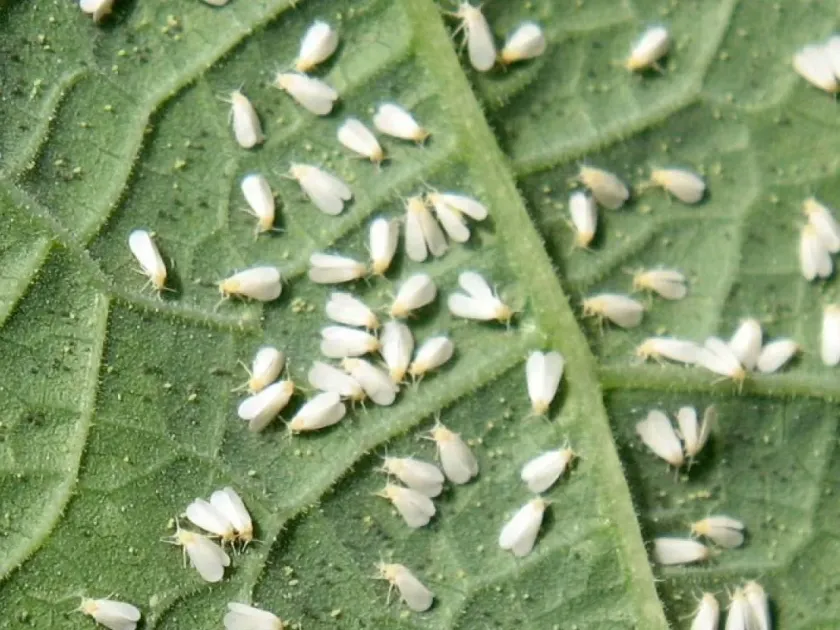
The maritime whitefly (Aleurodicus maritimus) is a small insect belonging to the Hemiptera order and the Aleyrodidae family. Adult specimens are distinguished by the white waxy powder covering their wings, giving them the appearance of tiny moths.
The life cycle encompasses several stages: egg, four larval (nymphal) instars, and the adult stage. Females typically deposit eggs on the underside of leaves, often arranging them in distinctive circular patterns marked by wax.
First-instar nymphs are mobile, allowing them to locate suitable feeding sites, whereas later stages are sessile. They remain attached to the foliage and secrete waxy filaments that provide protection against predators and desiccation.
Precise identification of this species often necessitates microscopic examination of the puparia, specifically focusing on the morphology of the respiratory tubes and the structure of the wax-producing glands.
This species is highly adapted to warmer environments. In regions with harsher winters, infestations are most commonly observed in greenhouses or indoor cultivation facilities where the climate remains stable throughout the year.
What it damages
The maritime whitefly is a polyphagous pest capable of infesting a wide range of agricultural crops and ornamental plants. It feeds by inserting its mouthparts into the plant tissue to extract sap, causing systemic stress to the host.
Continuous feeding causes the leaves to lose turgor, turn yellow (chlorosis), and eventually deform. This reduces the photosynthetic capacity of the plant and hinders its overall growth and development.
The secretion of honeydew is a primary symptom, which serves as a substrate for the growth of sooty mold. This dark fungal coating further obstructs light absorption and gas exchange through the stomata.
Heavy infestations can lead to significant yield losses. In severe cases, especially among young plants or seedlings, the damage can be fatal, resulting in total crop failure if not addressed timely.
In addition to physical damage, this pest is a known vector for various plant viruses, posing an additional layer of economic risk to greenhouse operations and nursery production.
Signs of infestation
The most prominent sign of an infestation is the presence of adult whiteflies that take flight in a cloud when the host plant is disturbed or shaken. They primarily congregate on the undersides of leaves.
A sticky, shiny residue on the foliage indicates the presence of honeydew. Over time, this substance attracts sooty mold, appearing as black soot patches on the leaves and stems.
Inspecting the underside of the leaves reveals the presence of nymphs, which look like small, flat, white or translucent scales. Waxy patches and white ring-like formations are indicative of active egg-laying.
Plants showing signs of infestation appear stunted and wilted. Prolonged feeding causes the leaves to curl, yellow, and drop prematurely, leading to a general decline in the plant's health and vigor.
Monitoring using yellow sticky cards is an effective diagnostic tool. Detecting the first adults allows for early intervention before the population reaches an uncontrollable level.
Control measures
Effective management of the maritime whitefly requires an integrated pest management (IPM) approach that combines cultural, biological, and chemical strategies.
Rigorous phytosanitary practices are essential, including the inspection of all new plant material and the removal of weeds that serve as alternative hosts for the whitefly population.
Biological control methods are highly effective in controlled environments. Introducing parasitic wasps, such as Encarsia species, can significantly reduce the larval population without chemical residues.
Chemical control should rely on systemic insecticides. It is crucial to implement a rotation of products with different modes of action to prevent the development of insecticide resistance in the pest population.
- Use yellow sticky traps for consistent monitoring of adult population density.
- Prune and dispose of heavily infested leaves or plants to reduce the initial inoculum.
- Maintain proper plant spacing and humidity to create less favorable conditions for development.
- Apply horticultural oils or soap-based sprays for small-scale control or organic production.
- Follow local regulations and guidelines regarding the application frequency of pesticides.
Taxonomy
- Latin name
- Aleurodicus maritimus
- Order
- Hemiptera (bugs, aphids, leafhoppers)
- Family
- Aleyrodidae
- EPPO code
- ALEDMR
Discussion
No discussions yet — be the first.