
Woolly whitefly
Aleurodicus floccissimus
Description
How to identify
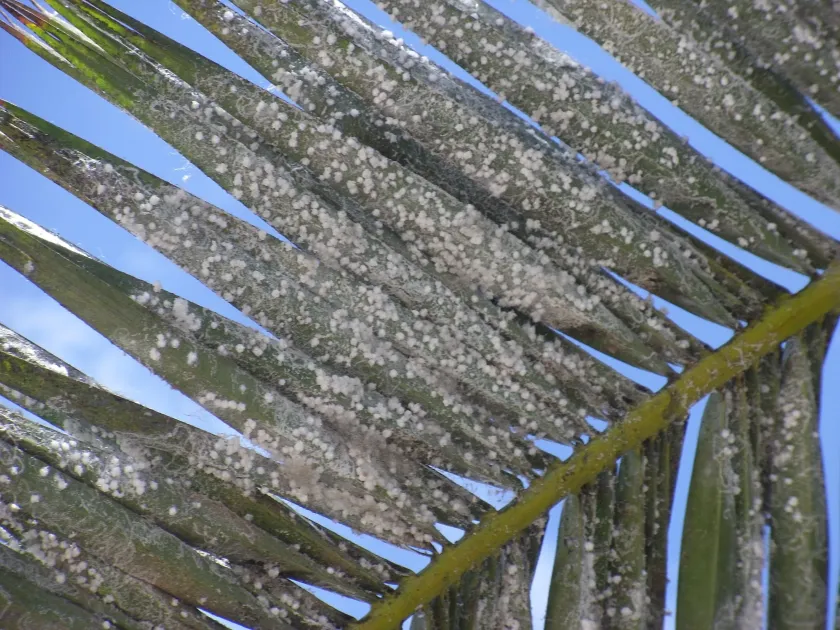
The woolly whitefly (Aleurodicus floccissimus) belongs to the Aleyrodidae family of the order Hemiptera. It is easily identified by the distinct, white waxy filaments that cover both the adults and the nymphs, creating a wool-like appearance.
Adults possess two pairs of wings covered in a powdery wax layer, giving them a ghostly white look. They are typically found on the undersides of leaves, where they remain stationary for long periods.
The life cycle progresses through several nymphal instars. After a brief mobile stage, the nymphs anchor themselves to the leaf surface, forming dense clusters protected by their secretions.
This species is highly adapted to sucking plant sap, using its specialized piercing-sucking mouthparts to reach the phloem tissues of the host plant.
Due to the waxy protective coat, this insect is significantly more resilient to standard environmental stressors and many traditional chemical treatments compared to other whitefly species.
What it damages
This pest attacks a wide range of host plants, including citrus, palms, various tropical trees, and diverse ornamental shrubs commonly found in gardens and greenhouses.
By extracting sap, the infestation leads to nutrient depletion, resulting in chlorosis, leaf curl, and eventually premature leaf abscission if left unchecked.
A major indirect damage is the production of copious amounts of honeydew. This sticky substance promotes the growth of sooty mold, which coats the leaves and impairs photosynthesis.
In addition to direct physiological damage, the woolly whitefly can act as a vector for various plant viruses, further compromising the health of the host.
The aesthetic damage to ornamental plants can be severe, leading to significant economic losses in commercial nurseries and indoor landscaping operations.
Signs of infestation
The most reliable sign of an infestation is the presence of fluffy, white, cotton-like masses on the undersides of leaves where the nymphs reside.
Leaves often appear shiny and sticky due to the accumulation of honeydew, which is a key indicator of an active whitefly colony.
The development of black sooty mold on the foliage is a secondary symptom that frequently occurs as a result of the honeydew buildup.
When an infested branch is shaken, a cloud of small, white adults will fly off, which is a characteristic behavioral response of the pest.
Stunted growth of new shoots and the yellowing or mottling of leaves are typical signs of the plant's overall decline due to nutrient deficiency.
Control measures
Managing the woolly whitefly requires a multi-faceted strategy because their waxy coating often prevents contact insecticides from reaching the insect's body.
Implementing a monitoring program using yellow sticky cards is essential for early detection, allowing for rapid intervention before the population reaches critical levels.
- Applying systemic insecticides that are translocated through the plant tissue to reach the sap-feeding insects.
- Releasing biological control agents, such as predatory mites or specific parasitoid wasps that target whitefly nymphs.
- Using insecticidal soaps or horticultural oils to manually wash away the waxy secretions and dehydrate the insects.
Sanitation practices, such as pruning and destroying heavily infested plant material, are critical for limiting the spread of the population within a garden or greenhouse.
Maintaining proper cultural practices, including optimal ventilation and avoiding over-fertilization, helps minimize the plant's susceptibility to whitefly outbreaks.
Taxonomy
- Latin name
- Aleurodicus floccissimus
- Order
- Hemiptera (bugs, aphids, leafhoppers)
- Family
- Aleyrodidae
- EPPO code
- LECOFL
Discussion
No discussions yet — be the first.