
Giant whitefly
Aleurodicus dugesii
Description
How to identify
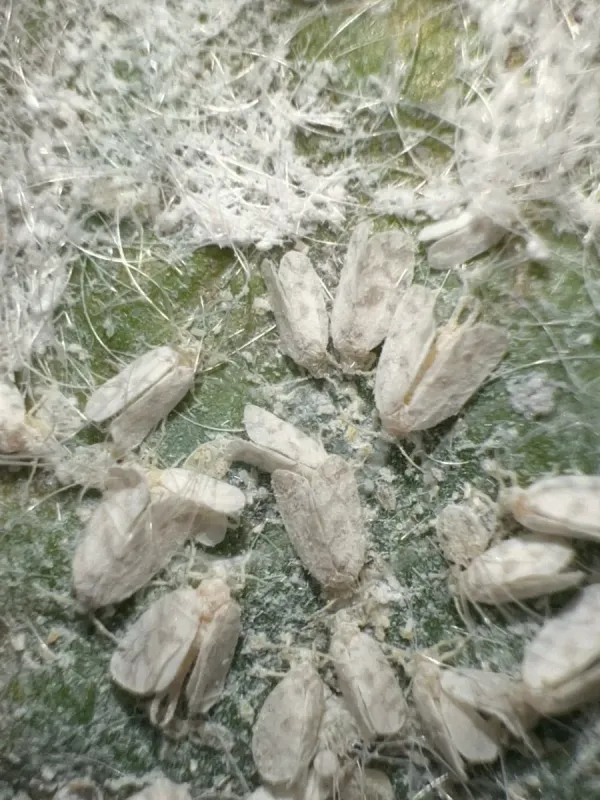
The Giant whitefly (Aleurodicus dugesii) is a large sap-sucking insect belonging to the family Aleyrodidae. It is significantly larger than the common greenhouse whitefly, with adults measuring between 3 and 5 mm in length.
The adult body is covered in a thick, fluffy white wax layer that gives the insect a cotton-like appearance. Its wings are broad and possess distinct venation, which serves as a key diagnostic feature for experts and scouts.
The nymphs go through several developmental stages, often settling on the undersides of leaves. They are surrounded by conspicuous white waxy filaments, which frequently form characteristic spiral patterns on the leaf surface.
The biological cycle is heavily influenced by temperature, allowing for year-round reproduction in warmer climates or greenhouse environments. This continuous development makes management challenging if not addressed early.
Female whiteflies are highly prolific, laying eggs in unique spiral patterns on younger leaves, which is a hallmark indicator of this specific species' presence in a new area.
What it damages
This pest has a wide host range, primarily affecting ornamental shrubs, trees, and various fruit crops. Common hosts include hibiscus, roses, citrus trees, ficus species, and grapevines.
Being a polyphagous insect, the Giant whitefly can quickly establish itself in nurseries and greenhouses, moving between diverse plant species and causing widespread economic damage to growers.
The insects target young, succulent shoots, draining plant nutrients and causing significant stress. This leads to stunted growth and a general decline in the plant's physiological health.
Infestations are often accompanied by the production of large amounts of honeydew. This sticky substance promotes the growth of sooty mold, which covers the leaf surface and blocks sunlight.
As the population density increases, the damage becomes visible through foliage yellowing, leaf curling, and premature dropping of buds and flowers, rendering decorative plants unsellable.
Signs of infestation
The presence of dense white waxy filaments on the underside of leaves is the most obvious sign. While often mistaken for fungal growth, these are distinctly associated with the insects themselves.
Sticky honeydew buildup on lower leaves or stems indicates an active colony. This sugary secretion is a primary indicator that the infestation has reached a stage requiring immediate treatment.
Sooty mold colonization, which appears as a black coating on leaves, is a secondary effect that indicates the infestation has been present for some time and is negatively impacting photosynthesis.
If you shake an infested branch, adult whiteflies will immediately take flight in large numbers. This visible cloud of insects is a clear signal that the pest population has reached critical levels.
The distinct spiral-shaped egg clusters found on the undersides of young leaves provide a definitive diagnostic marker, allowing for the early identification of new infestation points before significant damage occurs.
Control measures
Controlling the Giant whitefly is difficult because the waxy covering protects the nymphs from many contact insecticides. Therefore, systematic approaches are essential for effective management.
The use of systemic insecticides, particularly those belonging to the neonicotinoid class, is highly recommended as they are absorbed into the plant and target the insect through sap ingestion.
Cultural practices are vital: improving ventilation, pruning heavily infested areas, and avoiding plant crowding are effective ways to reduce humidity and prevent the rapid spread of the pest.
Biological control using parasitoid wasps, such as species of Encarsia or Eretmocerus, has proven successful in greenhouse settings, as these natural enemies target the whitefly larvae directly.
- Utilize yellow sticky traps to monitor adult flight and reduce their numbers.
- Apply insecticidal soaps to mechanically remove the protective wax and expose nymphs to treatments.
- Implement strict quarantine protocols for any new plant material entering the facility.
- Perform regular, detailed inspections focusing on the undersides of young foliage.
Taxonomy
- Latin name
- Aleurodicus dugesii
- Order
- Hemiptera (bugs, aphids, leafhoppers)
- Family
- Aleyrodidae
- EPPO code
- ALEDDU
Discussion
No discussions yet — be the first.