
Jasmine whitefly
Aleuroclava jasmini
Description
How to identify
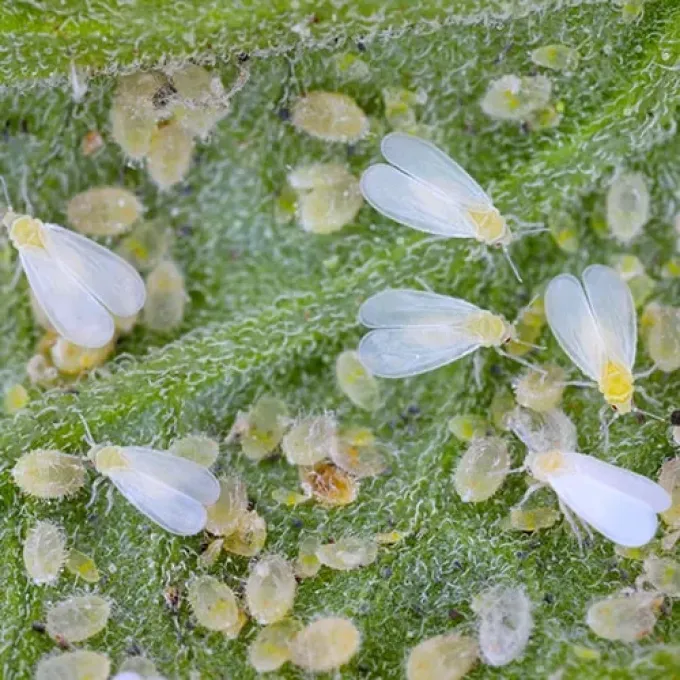
The Jasmine whitefly (Aleuroclava jasmini) belongs to the order Hemiptera and the family Aleyrodidae. It is a tiny insect, with adults reaching a length of only 1–1.5 mm, characterized by two pairs of wings covered with a white, mealy wax powder.
The larvae of this pest are mobile in their early stages but soon become sessile, developing a flat, oval shape. During this stage, they resemble small scales firmly attached to the underside of the leaves.
The color of the larvae ranges from pale yellow to brownish, making them difficult to detect on the leaf surface. Field identification often requires a magnifying glass to inspect the characteristic wax secretions produced by the nymphs.
Systematically, this species is considered a dangerous pest in both greenhouse and outdoor environments, with a high potential for rapid spread in warm climates. Adult insects are most active during the day, making short flights when the host plant is disturbed.
The biological cycle includes the egg stage, three larval stages (nymphs), and the puparium stage. The duration of a full generation cycle depends heavily on temperature and humidity, typically ranging from 20 to 40 days.
What it damages
The primary food source for this species is plants of the Oleaceae family, particularly various species of jasmine. However, its host range can include other ornamental or agricultural plants growing in close proximity.
The insects extract cell sap from plant tissues, which disrupts metabolic processes and stunts growth. Intense feeding causes yellowing and premature leaf drop, significantly reducing both the aesthetic and biological vigor of the plant.
In addition to direct damage from sap-sucking, whiteflies excrete honeydew. This sticky substance serves as an ideal medium for the growth of sooty mold, which covers leaves in a black layer, effectively blocking the process of photosynthesis.
Damaged plants become highly susceptible to secondary infections, including viral diseases transmitted by whiteflies while piercing the leaf tissue. High pest populations often lead to the mass drying of shoots.
The most severe damage is observed in greenhouses and nurseries, where the lack of natural predators and stable temperatures allow the pest to reproduce uncontrollably throughout the year.
Signs of infestation
The first sign of a whitefly infestation is the presence of tiny white insects on the undersides of leaves that scatter when the plant is shaken. Shiny, sticky patches caused by insect excretions are also clearly visible on the foliage.
Over time, yellow spots appear on the leaves, eventually merging and causing deformation and curling. The plant begins to lag in growth, and premature shedding of buds and flowers is often observed.
A black sooty mold covering the leaf surface is a reliable indicator of an advanced infestation stage. This symptom requires immediate intervention, as the plant is already under severe stress.
Small, translucent, or whitish scales (puparia) on the underside of leaves confirm the presence of an active pest population. Inspection of terminal shoots often reveals the highest concentration of larvae during active growth phases.
At night or in low light, a characteristic "dust" may be noticed on the leaves, which upon closer inspection, turns out to be a massive accumulation of adults and their excrement.
Control measures
Controlling the Jasmine whitefly requires an integrated approach combining agrotechnical, biological, and chemical methods. Regular monitoring of plant health using yellow sticky traps is essential.
Agrotechnical measures include regular greenhouse ventilation, weed control, and the removal of heavily infested plant parts. Increasing ambient humidity can sometimes slow down the pest's reproductive rate.
Biological control involves the use of natural enemies such as predatory bugs, lacewings, or parasitic wasps (e.g., Encarsia formosa), which are highly effective at suppressing larval populations.
Chemical control necessitates the use of systemic insecticides, as the pest often hides on the underside of leaves and is protected by a waxy coating. Products based on neonicotinoids and other modern active ingredients are generally effective.
- Deploying yellow sticky traps to reduce the adult population.
- Regular washing of leaves with soapy water or garlic extract to remove sticky honeydew.
- Application of specialized insecticides according to the manufacturer's instructions.
- Strict quarantine measures when introducing new plants.
- Prompt removal and disposal of heavily infested shoots.
Taxonomy
- Latin name
- Aleuroclava jasmini
- Order
- Hemiptera (bugs, aphids, leafhoppers)
- Family
- Aleyrodidae
- EPPO code
- ALTRJA
Discussion
No discussions yet — be the first.