
Citrus spiny whitefly
Aleurocanthus spiniferus
Description
How to identify
The citrus spiny whitefly (Aleurocanthus spiniferus) belongs to the order Hemiptera and the family Aleyrodidae. Unlike many other whitefly species, adult individuals have a dark, bluish-black appearance, making them visually distinct.
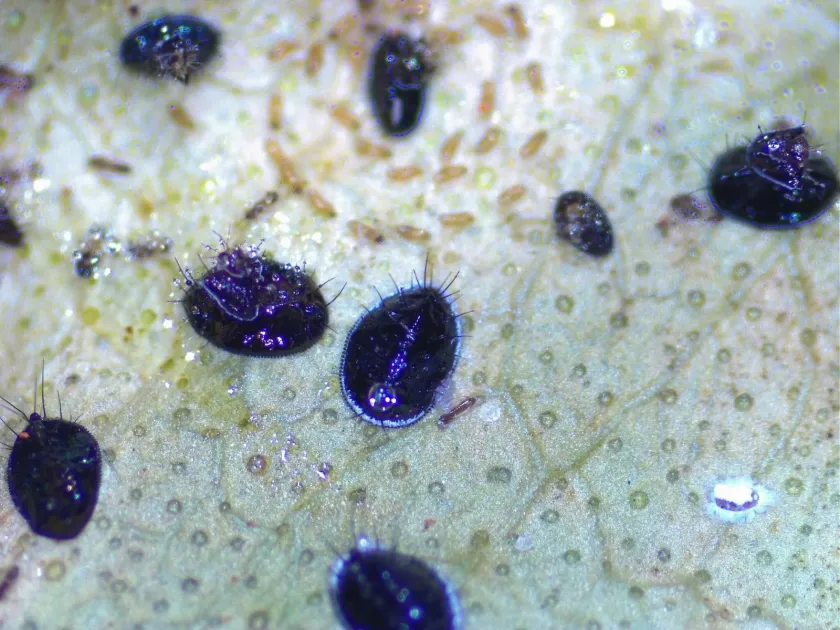
The larval stages are characterized by a dark or black color with a fringe of long, sharp spines around the edges, which is the defining feature of this specific pest.
The life cycle progresses through the egg, three larval instars, puparium, and adult stages, with developmental speed highly dependent on environmental temperature and humidity.
They are primarily found on the underside of leaves, which provides them with protection from predators and environmental stressors, as well as easy access to plant sap.
This species is globally recognized as a significant quarantine pest due to its high reproductive potential and its ability to rapidly infest various woody plants.
What it damages
The primary hosts of the citrus spiny whitefly include citrus trees like lemons, oranges, and mandarins, but it also impacts grapes, roses, and various ornamental shrubs.
Both adults and nymphs feed by sucking sap from leaves and young shoots, causing the plant to lose vital nutrients, which leads to stunted growth and reduced vigor.
The pest excretes large quantities of honeydew, which serves as a breeding ground for sooty mold, a fungus that covers leaves in a thick, dark, powdery layer.
This fungal growth blocks sunlight, severely inhibiting the plant's ability to photosynthesize, which in turn causes leaf yellowing, drop, and poor fruit quality.
Heavy infestations can lead to severe dieback of twigs and, if left unchecked, the complete decline and death of the host plant over several growing seasons.
When it appears
Aleurocanthus spiniferus typically produces multiple generations per year, with the frequency determined by regional climatic conditions and the availability of hosts.
Activity peaks during warmer months when favorable temperatures allow for rapid development of the population, often leading to overlapping generations on the same plant.
In greenhouses or climates with mild winters, the whitefly can remain active throughout the entire year, posing a year-round threat to agricultural nurseries.
Dispersal to new areas occurs mainly through the movement of infested seedlings, cuttings, or fruit, which can harbor eggs or dormant larval stages on their surfaces.
The onset of spring signals the start of the most active period, as adults migrate to newly emerged foliage to lay eggs and begin the cycle anew.
Signs of infestation
Initial signs of an infestation include the presence of numerous small, black, spiny nymphs attached firmly to the undersides of leaves.
A major diagnostic sign is the appearance of sticky honeydew on the foliage, followed by the development of a dark, soot-like fungal growth on the leaves and stems.
Upon disturbing the canopy of an infested tree, a noticeable swarm of tiny, dark-winged adults will emerge, confirming the presence of an established population.
Plants affected by the pest often display signs of chlorosis, leaf curl, and a general lack of health, which becomes more pronounced as the infestation persists.
- Sticky leaves covered in honeydew.
- Development of black sooty mold.
- Visible colonies of spiny black larvae.
- Premature leaf senescence and drop.
- Reduced vitality and stunted shoot growth.
Control measures
Stringent quarantine measures are the first line of defense; inspect all incoming nursery stock carefully to prevent the introduction of this pest into new areas.
Biological control methods are highly recommended, specifically the introduction of parasitic wasps like Encarsia smithi, which effectively parasitize and reduce whitefly populations.
Chemical control can be implemented using systemic insecticides, but it must be managed carefully to prevent the whitefly from developing resistance to common chemical groups.
Sanitation is crucial; pruning and safely destroying infested foliage or heavily damaged branches will significantly lower the population density within an orchard.
Application of horticultural oils or soap-based sprays is effective against the nymphal stages, as they work by suffocating the insects and disrupting their development.
Taxonomy
- Latin name
- Aleurocanthus spiniferus
- Order
- Hemiptera (bugs, aphids, leafhoppers)
- Family
- Aleyrodidae
- EPPO code
- ALECSN
Discussion
No discussions yet — be the first.