
Black citrus whitefly
Aleurocanthus niger
Description
How to identify
The black citrus whitefly (Aleurocanthus niger) belongs to the order Hemiptera and the Aleyrodidae family. Unlike the common greenhouse whitefly, adults of this species have distinctive dark, smoky wings.
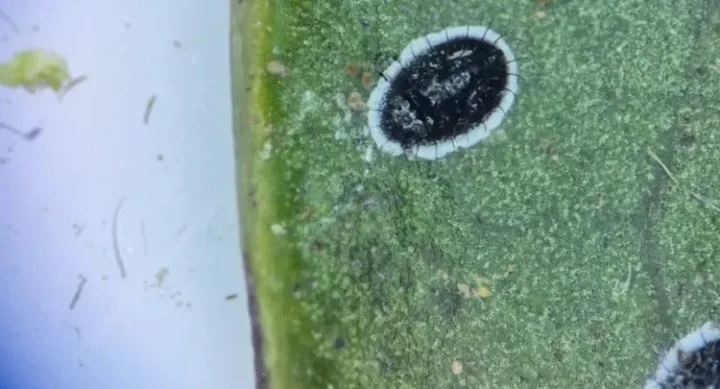
The life cycle includes an egg, several larval stages, a puparium, and the adult stage. The puparia are jet black, oval-shaped, and characterized by a white waxy fringe along the margin, making them easily distinguishable.
Females are highly prolific and typically lay their eggs in spiral patterns on the undersides of leaves, which serves as a key diagnostic feature for field identification.
This pest is a significant quarantine threat in many tropical and subtropical regions. Its high reproductive rate allows it to quickly colonize entire orchards if left unchecked.
Field identification involves examining the lower leaf surface, where the sessile larval stages remain fixed and protected by their waxy, dark-colored exoskeletons.
What it damages
The black citrus whitefly primarily affects citrus trees, including lemon, lime, orange, and grapefruit. It also occasionally attacks other woody hosts, impacting both yield and tree vigor.
Feeding occurs by piercing leaf tissue and sucking sap, which drains the plant of vital nutrients. This leads to weakened trees, sparse foliage, and stunted growth.
The excretion of large amounts of honeydew is a major consequence of infestation. This sticky substance covers the leaves, creating an environment for the growth of sooty mold.
Sooty mold prevents photosynthesis by blocking sunlight, eventually leading to reduced fruit size, diminished quality, and potential loss of the entire harvest.
Persistent infestations can cause significant defoliation and branch dieback, ultimately threatening the long-term survival of the infested trees.
When it appears
The pest's activity is heavily influenced by climate. In favorable warm conditions, the population can complete multiple generations within a single year.
Spring and summer are the peak periods for adult emergence and active egg-laying, coinciding with the development of new plant growth.
In greenhouse settings or indoor nurseries, the species can continue its life cycle year-round, requiring constant vigilance to prevent total crop loss.
Long-distance spread is primarily facilitated by the movement of infested nursery stock or fruit from regions where the pest is already established.
During cooler periods, development slows down, but the puparium stage remains resilient, allowing the pest to survive temporary adverse environmental conditions on evergreen leaves.
Signs of infestation
Visible clusters of small, black, oval-shaped puparia on the underside of leaves are the most reliable sign of a developing infestation.
A shiny, sticky coating on the foliage and branches is a clear indicator of honeydew production by the nymphs, signaling a high-density population.
The development of a dense black sooty mold layer on leaves and fruit is a secondary symptom that often alerts growers to the presence of the pest.
Yellowing, curling, and premature dropping of leaves are common signs that the tree is suffering from severe sap loss due to high pest pressure.
Upon disturbing the foliage, a visible cloud of small dark flies rising from the tree canopy confirms the presence of adult Aleurocanthus niger.
Control measures
Effective management begins with rigorous quarantine protocols to prevent the introduction of infested plant material into new growing areas.
Chemical control is often necessary, utilizing systemic insecticides that are applied during the crawler stage to effectively interrupt the life cycle.
Integrating different pesticide classes helps prevent the development of insecticide resistance, which is a common challenge with various whitefly species.
- Pruning and destroying heavily infested branches to reduce the initial pest population.
- Using horticultural oils to smother eggs and nymphs by blocking their respiration.
- Promoting biological control through the release of parasitoid wasps, such as Encarsia species.
Monitoring using yellow sticky traps is an essential practice for detecting initial arrivals and timing spray applications for maximum efficacy.
Taxonomy
- Latin name
- Aleurocanthus niger
- Order
- Hemiptera (bugs, aphids, leafhoppers)
- Family
- Aleyrodidae
- EPPO code
- ALECNG
Discussion
No discussions yet — be the first.