
Camellia whitefly
Aleurocanthus camelliae
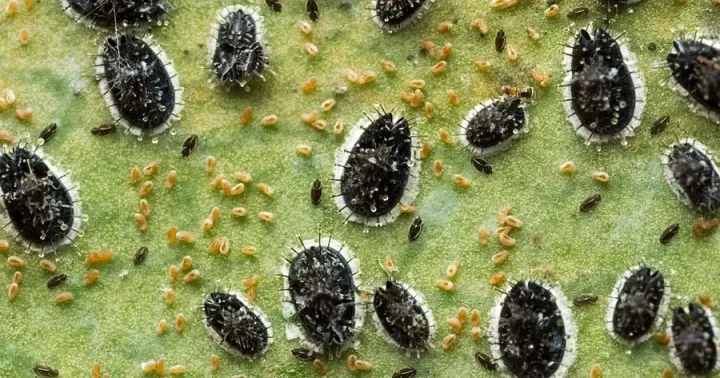
Description
How to identify
The Camellia whitefly (Aleurocanthus camelliae) belongs to the order Hemiptera and the family Aleyrodidae. It is a highly specialized insect known for causing significant damage to broad-leaved evergreen plants.
The adult insect has a distinct dark body and often exhibits a powdery or waxy appearance, which distinguishes it from the more common greenhouse whitefly species. Its size is generally small, making detection difficult without close inspection.
Its life cycle consists of egg, three larval instars, puparium, and adult stages. The insect spends the majority of its life cycle attached to the underside of the leaves, feeding on plant phloem.
This pest is particularly successful in colonizing plants in environments with stable temperatures, such as glasshouses, greenhouses, or indoor plant collections.
Correct taxonomic identification of Aleurocanthus camelliae often requires microscopic analysis of the puparial stage, which displays unique structural features.
What it damages
The Camellia whitefly primarily infests plants in the genus Camellia. However, it can also affect various citrus species and other ornamental shrubs commonly found in Mediterranean-style gardens or greenhouses.
The primary damage is caused by the nymphs and adults sucking sap from the leaves. This leads to severe chlorosis, loss of leaf turgor, and overall weakening of the host plant.
The insects secrete large amounts of honeydew, a sticky substance that promotes the growth of sooty mold. This dark fungal growth coats the leaves, blocking sunlight and severely impeding photosynthesis.
Chronic infestation results in stunted growth, premature defoliation, and a significant loss of the plant's aesthetic value, which is critical for nursery and ornamental production.
In extreme cases, the combination of sap depletion and secondary fungal infection can lead to the death of entire branches or the entire plant.
When it appears
In temperate climates, the Camellia whitefly activity peaks during the warmer months. Development is accelerated by high temperatures and adequate humidity.
In greenhouses or controlled indoor environments, the pest can reproduce continuously throughout the year, with overlapping generations making control efforts challenging.
The migration of adults typically occurs during periods of calm, warm weather. They fly from infested plants to healthy neighbors, rapidly expanding the scope of the infestation.
Monitoring should be increased during the transition to spring and summer, when plant growth is vigorous and the insects find abundant fresh foliage to feed upon.
Environmental management, including ventilation and temperature control, can help reduce the suitability of the environment for the pest's rapid reproduction.
Signs of infestation
The most prominent sign of infestation is the appearance of sticky honeydew on the leaves and sometimes on the ground beneath the plant. Over time, this turns black due to the growth of sooty mold.
Upon inspecting the underside of the leaves, one can find small, dark, and flat puparia. These are stationary and firmly attached to the leaf epidermis, often resembling scales.
Leaves may show yellowing (chlorosis) or irregular spots where the insects have inserted their mouthparts. Heavily infested leaves eventually become deformed and may curl.
- Sticky honeydew residue on foliage.
- Development of black, velvety sooty mold.
- Yellowing and loss of leaf vigor.
- Presence of small flying insects when foliage is disturbed.
Using yellow sticky traps in the vicinity of susceptible plants is a highly effective way to detect the presence of adult whiteflies early in the infestation process.
Control measures
Controlling the Camellia whitefly requires an integrated pest management (IPM) strategy. Chemical control alone is often insufficient due to the pest's ability to develop resistance.
Systemic insecticides applied as soil drenches or foliar sprays are effective because they translocate through the plant, reaching the insect regardless of its location on the leaf.
Biological control, using specific parasitoids or predatory mites, can be highly effective in greenhouses, significantly lowering the population density without using toxic chemicals.
Good horticultural practice, such as thinning out dense foliage to improve airflow and physically removing heavily infested leaves, is essential to limit the spread of the pest.
Consistent monitoring and alternating the chemical class of pesticides are crucial to prevent the survival of resistant individuals and ensure long-term suppression of the whitefly population.
Taxonomy
- Latin name
- Aleurocanthus camelliae
- Order
- Hemiptera (bugs, aphids, leafhoppers)
- Family
- Aleyrodidae
- EPPO code
- ALECCA
Discussion
No discussions yet — be the first.