
Common kingfisher
Alcedo atthis
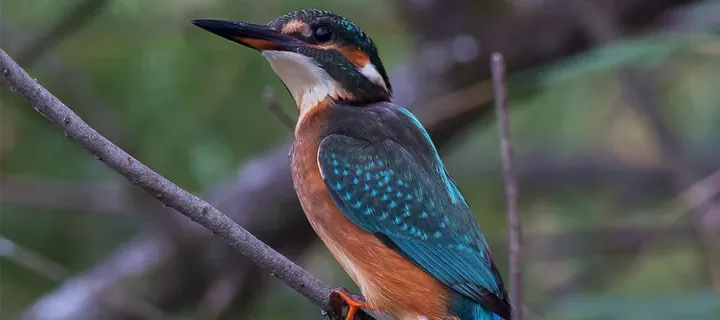
Description
How to identify
The common kingfisher Alcedo atthis belongs to the order Coraciiformes, family Alcedinidae. It is a small bird easily recognized by its vibrant blue and orange plumage.
Key identification features include a long, dagger-like bill, a large head, and a very short tail. These birds inhabit areas near stagnant or slowly flowing waters.
The species is highly territorial and is often seen perched on low-hanging branches over water bodies, scanning for small fish to hunt.
In an agricultural context, they are viewed as a significant nuisance for commercial fish farms that manage small fry and fingerlings.
Their life cycle involves nesting in burrows dug into vertical earth banks, which provides protection for their offspring near water sources.
What it damages
The primary damage caused by the common kingfisher in aquaculture is the depletion of juvenile fish populations in nursery ponds.
These birds specialize in hunting small fish, directly impacting the profitability of fish farms by reducing the quantity of stock reaching harvestable size.
High-density ponds are particularly attractive to kingfishers, as they provide easy access to prey during daylight hours when fish are active near the surface.
Beyond individual losses, the constant presence of a predator causes significant stress to the fish stock, potentially lowering growth rates and increasing disease susceptibility.
A single breeding pair and their brood can consume hundreds of fish over a short period, leading to cumulative economic losses for the farmer.
Signs of infestation
The presence of a kingfisher is often signaled by a sharp, high-pitched whistle and a rapid, low-altitude flight pattern across the surface of the pond.
Observation points, such as specific reeds or posts sticking out of the water, where remnants of fish bones or scales are found, confirm their feeding activity.
The appearance of small, round burrow holes on steep banks near the ponds indicates that the birds have established a nest in the vicinity.
Sudden, unexplained drops in fish numbers, especially among fingerlings, without signs of water pollution or disease, often point to predatory bird attacks.
Regular sightings of the characteristic bright blue streak moving quickly over the water surface are clear indicators that the site is being exploited by kingfishers.
Control measures
The most effective physical barrier is the installation of overhead netting or tensioned wires across the pond, which prevents the birds from diving.
Removing potential perches, such as overhanging branches or posts, around the pond perimeter forces the birds to hunt elsewhere as they lose their vantage points.
Visual deterrents, such as decoy raptors or reflective objects, can provide temporary relief but are often less effective as birds tend to habituate quickly.
Maintaining adequate pond depth allows fish to retreat to deeper zones, making them less accessible to kingfishers that rely on shallow-water hunting.
Integrated pest management strategies should prioritize non-lethal deterrents, as kingfishers are protected by conservation laws in many regions globally.
Taxonomy
- Latin name
- Alcedo atthis
- Family
- Alcedinidae
- EPPO code
- ALCEAT
Discussion
No discussions yet — be the first.