
Rice leaf miner
Agromyza oryzae
Description
How to identify
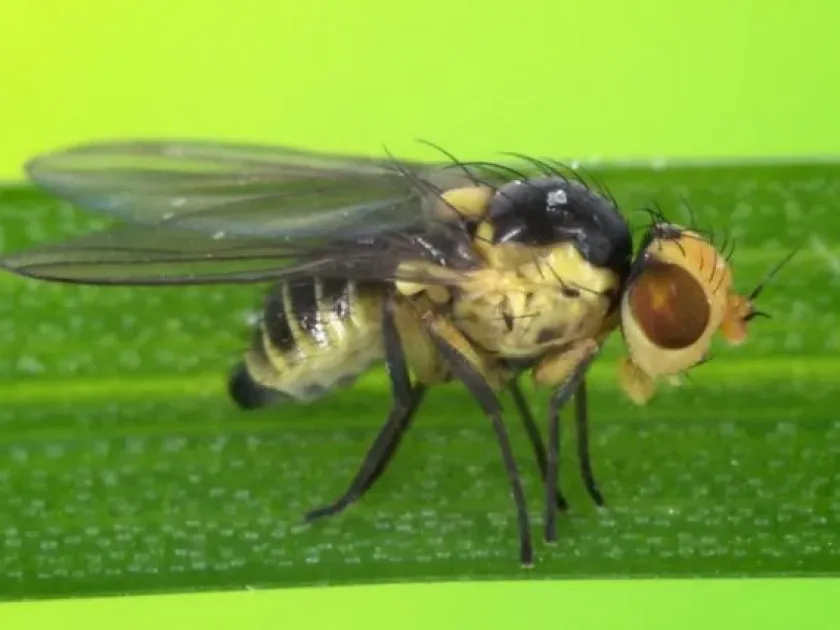
The Rice leaf miner (Agromyza oryzae) belongs to the Agromyzidae family of the order Diptera. These are tiny flies, typically measuring between 2 and 3 millimeters in length.
The adults are characterized by a dark, metallic-black body and transparent wings, which are adapted for short, rapid flight during mating and egg-laying periods.
Larvae are legless, cylindrical, and cream-colored, specifically adapted for life inside the narrow galleries they excavate within the leaf tissue.
The life cycle encompasses four distinct stages: egg, larva, pupa, and adult. The females lay eggs by inserting them into the epidermis of the rice leaf.
Pupation primarily occurs within the leaf mine, although some larvae may drop into the soil or water surface if the host plant becomes excessively damaged.
What it damages
The primary host for this pest is cultivated rice. The larvae feed on the mesophyll tissue between the upper and lower epidermis of the leaf.
Beyond rice, Agromyza oryzae can occasionally infest various grasses found in wetland habitats, which act as secondary hosts during the off-season.
The damage is most severe during the early vegetative stages, particularly during the tillering phase, where loss of photosynthetic area severely stunts growth.
Infestation results in the yellowing and necrosis of the leaves, which reduces the plant's ability to produce grains, ultimately leading to significant yield losses.
Moreover, the mining activities create entry points for secondary pathogens, which can cause severe bacterial or fungal blight in affected fields.
When it appears
Adult flies emerge in the spring as temperatures rise, often synchronizing their population peak with the appearance of young rice seedlings.
The fly can complete multiple generations within a single growing season, with the duration of the life cycle heavily dependent on ambient temperature and humidity.
High humidity and moderate temperatures create the most favorable conditions for larval development, leading to rapid expansion of the infested area.
Population density typically peaks in the middle of the growing season, before beginning to decline as the host plants mature and temperatures fluctuate.
The pest spends the winter months in a diapause state, either as pupae in soil or as adults residing in plant debris around the edges of the fields.
Signs of infestation
The most diagnostic sign is the appearance of white, winding tracks or mines on the leaves, caused by the larvae feeding under the epidermis.
These mines often merge, turning into large, chlorotic blotches. Eventually, the damaged portions of the leaf tissue dry out and turn brownish in color.
In cases of severe infestation, the leaves may curl and droop, giving the entire rice field a yellowed and sickly appearance from a distance.
One can identify the presence of the larva by inspecting the end of the mine, where a small dark spot (the larva itself) is often visible against the light.
The presence of adult flies hovering around the rice plants is a strong indicator that the egg-laying process is currently underway in the field.
Control measures
Effective management begins with proper field sanitation, including the destruction of weeds and volunteer rice plants that serve as reservoirs.
Water management is a critical tool; manipulating water levels in the paddies can create unfavorable conditions for larval development and pupation.
When infestation levels exceed the economic threshold, the application of systemic insecticides is necessary to protect the young rice seedlings from damage.
Biological control agents, such as parasitic wasps that target Agromyzidae larvae, can help regulate populations if chemical use is restricted.
- Utilizing resistant rice varieties adapted to the local environment.
- Regular monitoring with yellow sticky traps to track adult population levels.
- Proper disposal of post-harvest crop residues to destroy overwintering pupae.
Taxonomy
- Latin name
- Agromyza oryzae
- Order
- Diptera (flies)
- Family
- Agromyzidae
- EPPO code
- AGMYOR
Discussion
No discussions yet — be the first.