
Agalliana ensigera
Agalliana ensigera
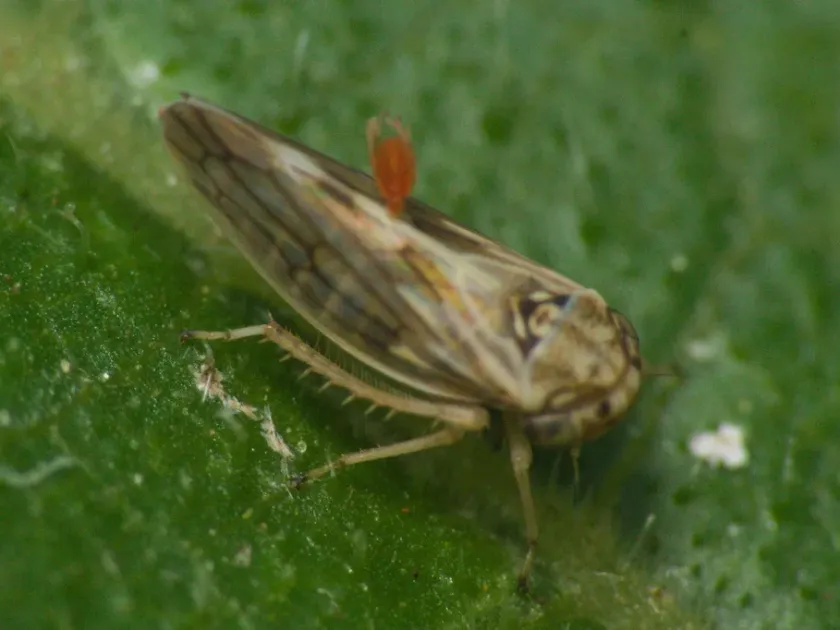
Description
How to identify
Agalliana ensigera is a species of leafhopper belonging to the family Cicadellidae within the order Hemiptera. These insects are characterized by their jumping hind legs and specialized feeding mouthparts.
Adults typically reach a length of 3–4 mm. They possess a streamlined body with a coloration that ranges from yellowish-grey to brown, often featuring subtle dark markings that provide camouflage on host plants.
Nymphs resemble smaller, wingless versions of the adults. They are highly active and primarily reside on the underside of leaves, where they feed on plant phloem sap throughout their development.
Reproduction follows a sexual cycle. Females deposit their eggs directly into the plant tissue, such as leaf petioles or veins, protecting them during the initial development stage.
This species thrives in warm and moderately humid environments, frequently establishing itself in agricultural landscapes where host plants like sugar beets are cultivated.
What it damages
The primary host of Agalliana ensigera is sugar beet, although it can also infest various other crops and weeds within the Chenopodiaceae family.
Both adults and nymphs cause direct damage by extracting sap from plant tissues. This nutrient loss disrupts the plant’s metabolism, leading to stunted growth and reduced photosynthetic efficiency.
The most severe impact is its role as a vector for viruses, particularly the beet curly top virus. Even small populations of these insects can transmit the virus, leading to significant yield losses across large fields.
Infested plants exhibit severe symptoms, including leaf yellowing, curling, and necrosis. These conditions drastically hinder the plant’s ability to store sugar in its roots.
During dry seasons, the damage is amplified as the plants, already stressed by moisture deficit, become more susceptible to the toxic effects of the leafhopper's saliva.
When it appears
The insect’s activity begins in the spring as temperatures rise, with initial colonies typically forming on weeds before migrating to agricultural crops.
Peak population densities usually occur during the first half of the summer, as favorable conditions facilitate the development of multiple consecutive generations.
The length of the lifecycle is highly dependent on ambient temperature, with warmer weather significantly accelerating the developmental rate of each generation.
As autumn approaches and temperatures drop, the leafhoppers migrate to overwintering sites, where they typically survive as adults in sheltered environments.
Common overwintering habitats include field margins, hedgerows, and uncultivated areas that retain sufficient vegetation for protection against winter conditions.
Signs of infestation
The first noticeable sign of an infestation is the appearance of plants with curly, deformed, and chlorotic leaves, which is often a secondary symptom of a viral infection transmitted by the insect.
Closer inspection of the underside of the leaves reveals the presence of small, jumping insects. They are highly sensitive to movement and quickly disperse when the plant is disturbed.
Feeding sites often show small, pale spots or puncture marks where the insect has inserted its proboscis to ingest sap, which can eventually lead to tissue death.
Inhibition of apical growth is a major sign, leading to the characteristic "curly top" appearance where leaves become stiff, thickened, and corrugated.
- General chlorosis (yellowing) of the leaves
- Inward curling of leaf margins
- Stunted development of the root system
- Wilting of young plants during hot hours
Control measures
Effective cultural control centers on the eradication of weeds near fields, which act as primary reservoirs for both the virus and the leafhopper population in early spring.
Implementing spatial isolation between new beet plantings and previous season's fields helps to prevent the early-season migration of leafhoppers from overwintering sites.
The application of systemic and contact insecticides is vital during the early colonization stage to minimize the risk of virus transmission throughout the field.
Monitoring populations using yellow sticky traps is a standard practice to detect the start of migration and to determine the optimal timing for chemical interventions.
Biological control efforts should focus on preserving natural enemies, including predatory spiders and certain bugs, which can play a significant role in suppressing leafhopper numbers.
Taxonomy
- Latin name
- Agalliana ensigera
- Order
- Hemiptera (bugs, aphids, leafhoppers)
- Family
- Cicadellidae
- EPPO code
- AGALEN
Discussion
No discussions yet — be the first.