
Pea aphid
Acyrthosiphon
Description
How to identify
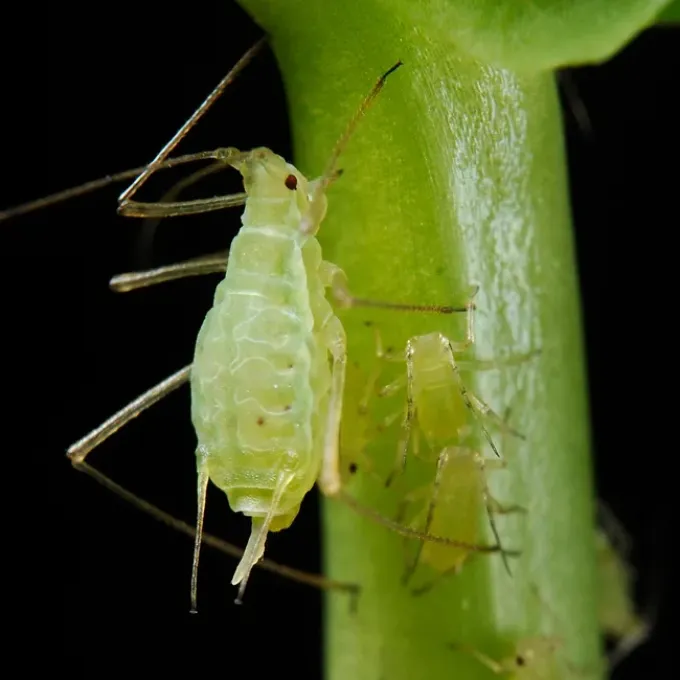
The pea aphid Acyrthosiphon pisum is a member of the Hemiptera order and the Aphididae family. This large aphid typically measures 4–5 mm in length and is characterized by a bright green or yellowish-green color.
Both winged and wingless forms exist within the population. Winged adults are highly mobile and facilitate the rapid spread of the pest across agricultural fields during the growing season.
The insect features long, thin legs and elongated antennae, allowing it to navigate efficiently on host plant stems. Nymphs resemble adults in appearance but are smaller and generally lighter in color.
These aphids typically colonize the growing points, young leaves, buds, and tender stems of host plants. Due to their tendency to feed in dense groups, their presence is easily detected during field scouting.
The life cycle involves both asexual reproduction during the summer and sexual reproduction in the autumn. Eggs overwinter on perennial legume hosts, and the first generation of nymphs emerges in the spring.
What it damages
The pea aphid is a major pest for various legume crops, including peas, alfalfa, clover, vetch, and lupines. It causes significant economic losses in regions with intensive grain legume production.
The most severe damage occurs during the flowering and pod-filling stages. By sucking sap from plant tissues, the aphid severely stresses the plant, reducing its metabolic activity and photosynthetic efficiency.
Beyond direct feeding damage, these aphids are vectors for several viruses, such as pea mosaic virus. Virus transmission often causes more yield loss than the physical damage caused by the aphid feeding itself.
Infested plants exhibit yellowing and stunted growth. In severe cases, the entire plant can wither, leading to a potential yield reduction of up to 50% if left unmanaged.
Heavy infestations prevent proper pod development, resulting in shriveled seeds and reduced grain weight. During periods of drought, the plants are unable to compensate for the stress, making them extremely susceptible to aphid pressure.
When it appears
Population growth typically begins in late spring or early summer, as temperatures consistently reach 15–18°C. The peak of activity usually coincides with the budding and flowering stages of the pea crop.
There are typically 10–12 generations per season. Under optimal conditions of 20–25°C, a generation can complete its development in as little as 7–10 days, leading to a rapid buildup of the population.
Mid-to-late summer is the critical period for aphid management, especially under dry weather conditions. During this time, winged individuals migrate extensively to new host plants.
As the days shorten and temperatures drop in autumn, sexual forms emerge. These produce eggs that are deposited on perennial forage legumes, where they enter diapause to survive the winter.
Natural enemies such as lady beetles, lacewings, and parasitic wasps play a key role in keeping populations in check; their conservation is vital for integrated pest management.
Signs of infestation
The first signs of infestation include curled, distorted young leaves that appear sticky due to the honeydew excreted by the aphids. Sooty mold often grows on this honeydew, giving the plants a blackened appearance.
Close inspection reveals colonies on the underside of leaves and within leaf axils. Heavy infestations cause buds to dry up, shrivel, and drop off before they can produce a crop.
The presence of ants is a common indicator of aphid colonies, as ants feed on the honeydew and often defend the aphids from natural predators.
Chlorotic spots on stems and leaves are evidence of prolonged feeding. These areas indicate where the aphid colony has been active, weakening the plant's overall vitality.
Viral infection symptoms, often associated with aphid feeding, include mosaic patterning on the foliage, leaf deformity, and uneven growth of the entire plant canopy.
Control measures
Cultural practices include spatial isolation of pea fields from perennial legume crops and maintaining strict weed control to remove alternative hosts for the aphid.
Early planting allows crops to reach maturity before the peak of aphid infestation. Selecting pest-resistant or tolerant varieties can significantly reduce the necessity for chemical intervention.
Systemic insecticides should be applied once the economic threshold is reached. These products are effective at reaching aphids deep within the crop canopy and offer residual protection.
Biological control, including the use of entomopathogenic fungi or beneficial insects, is a sustainable option for managing early-season or low-density infestations.
- Apply systemic insecticides during the budding/flowering stage.
- Maintain distance from perennial legume reserves.
- Encourage natural predator populations for biological control.
Taxonomy
- Latin name
- Acyrthosiphon
- Order
- Hemiptera (bugs, aphids, leafhoppers)
- Family
- Aphididae
- EPPO code
- ACYRSP
Discussion
No discussions yet — be the first.