
Cashew leaf miner
Acrocercops syngramma
Description
How to identify
The cashew leaf miner, Acrocercops syngramma, is a significant moth pest belonging to the order Lepidoptera and the family Gracillariidae.
Adult moths are small, delicate insects with narrow wings, often displaying cryptic patterns that provide effective camouflage against the tree bark.
The life cycle progresses from egg to larva, pupa, and adult, with the larval stage being the most damaging phase to the plant tissue.
Females deposit eggs on the surface of young leaves, ensuring that hatching larvae can immediately access the nutrient-rich succulent tissues.
The pupal stage occurs in a small, silky cocoon, which is frequently constructed on the underside of a leaf or within a folded leaf margin.
What it damages
This pest exclusively targets the cashew tree (Anacardium occidentale), causing severe physiological stress to plantations, especially in tropical climates.
The larvae feed on the internal leaf tissue, creating mines that destroy the palisade layer responsible for the majority of the photosynthetic activity.
Heavy infestations lead to leaf senescence and premature abscission, which significantly reduces the tree's vigor and its ability to store energy.
Reduced photosynthetic capacity directly impacts nut quality and size, often leading to reduced market value and decreased total harvest weight.
The presence of mines also causes physical distortion of young leaves, resulting in stunted shoot growth during the active vegetative phase.
Signs of infestation
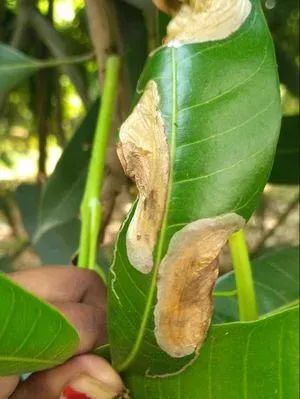
The primary symptom is the appearance of serpentine or blotch-like mines on the leaf surface, which start as pale tracks and gradually expand.
Dark fecal pellets left inside the tunnels by the larvae are a definitive diagnostic indicator of the presence of the cashew leaf miner.
Leaves affected by the larvae may turn brown and dry out, creating a scorched effect across the canopy of the infested cashew trees.
In cases of severe infestation, the edges of the leaves may roll and curl as the larvae create chambers for their transition to the pupal stage.
Regular visual inspections will reveal patches of translucent or dead tissue, which become brittle and easily tear under environmental stress.
Control measures
Integrated Pest Management (IPM) is crucial, starting with the early detection of mining symptoms during the flushing stage of the trees.
Manual removal and destruction of heavily infested leaves can significantly decrease the local population density of the pest.
Biological control methods, including the use of entomopathogenic bacteria or the protection of naturally occurring parasitoid wasps, are highly recommended.
Chemical control should only be implemented when damage thresholds are met, utilizing systemic insecticides that target the larvae inside the leaf mines.
- Use of pheromone traps to monitor adult moth activity.
- Ensuring balanced nutrient supply to support tree health.
- Maintaining field hygiene to prevent the spread of pupae via debris.
- Encouraging natural predators such as ladybirds and predatory mites.
Taxonomy
- Latin name
- Acrocercops syngramma
- Order
- Lepidoptera (butterflies)
- Family
- Gracillariidae
- EPPO code
- AROCSY
Discussion
No discussions yet — be the first.