
Clover leafhopper
Aceratagallia sanguinolenta
Description
How to identify
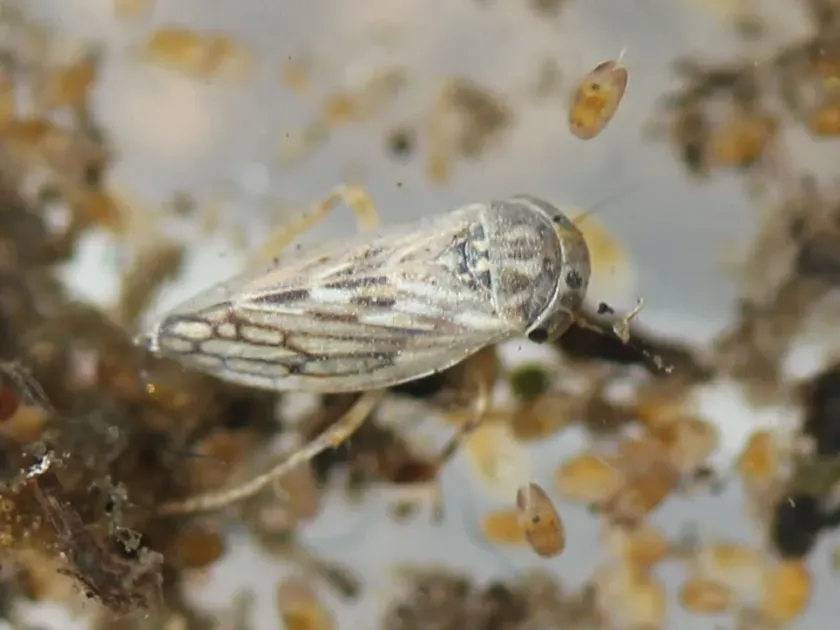
The clover leafhopper (Aceratagallia sanguinolenta) belongs to the family Cicadellidae within the order Hemiptera. These small insects, measuring approximately 3 mm in length, are easily recognized by their mottled appearance, typically ranging from light brown to gray.
Adults are equipped with powerful jumping hind legs and functional wings, allowing them to disperse quickly across fields when disturbed or in search of better host plants.
Nymphs resemble smaller, wingless versions of the adults. Throughout their development, they undergo several molting stages, gradually increasing in size and complexity.
Due to the vast diversity of leafhopper species, definitive identification often requires examining the microscopic morphological features of the male genitalia in a laboratory setting.
They prefer humid environments and are most commonly found within dense vegetation, where the microclimate protects them from extreme temperatures and desiccation.
What it damages
The clover leafhopper primarily attacks leguminous crops, including clover, alfalfa, and vetch, which are highly susceptible to their feeding activities throughout the growing season.
Besides agricultural crops, these insects exploit various weeds as alternative hosts, which facilitates the persistence of the population even when primary crops are harvested.
The most significant impact is not merely the mechanical damage to plant tissues, but the transmission of plant pathogens, particularly various viruses and phytoplasmas.
During drought conditions, the damage becomes more pronounced. Stressed plants struggle to recover from the sap-sucking activity, leading to reduced overall vigor and biomass production.
Severe infestations can result in significant economic losses, affecting both the yield of forage crops and the nutritional quality of the hay produced for livestock.
When it appears
These insects overwinter primarily as adults or late-stage nymphs, finding shelter in crop residues, plant litter, or the upper layers of the soil to survive the winter cold.
Activity resumes in early spring once temperatures are sufficiently high, at which point they begin feeding on perennial forage crops and emerging weed species.
The clover leafhopper produces multiple generations throughout the year, with the reproductive rate significantly increasing during warm summer months.
Population peaks typically occur during mid-summer, when environmental conditions are optimal for rapid development, mating, and egg-laying in the foliage.
As the season progresses toward autumn, the population begins to relocate to more protected areas with sufficient plant cover to prepare for the upcoming overwintering period.
Signs of infestation
The earliest sign of infestation is the appearance of tiny white speckles on the leaves, caused by the insect’s piercing-sucking mouthparts extracting plant fluids.
As the infestation continues, affected leaves may show signs of chlorosis, curling, or overall stunting, which are often mistaken for nutrient deficiencies in the soil.
A noticeable thinning of the plant stand and overall poor growth performance are common indicators in fields with heavy leafhopper populations.
Young seedlings are particularly vulnerable; high populations can cause significant mortality, leading to patchy crop emergence and reduced plant density.
Additionally, the presence of honeydew secreted by the leafhoppers can promote the growth of sooty mold, which coats the foliage and further hinders photosynthesis.
Control measures
Effective management begins with robust agronomic practices, including crop rotation and the diligent control of weeds that serve as early-season reservoirs.
Mowing field borders and adjacent non-crop areas can help reduce the local population of leafhoppers before they migrate into the main crop field.
Chemical control should be employed only when monitoring thresholds are exceeded, utilizing systemic insecticides to target the developing nymphs effectively.
Implementing integrated pest management (IPM) strategies, such as using sticky traps for population monitoring, allows for precise timing of interventions.
Conserving and encouraging natural predators, such as spiders and parasitic wasps, plays a vital role in keeping leafhopper populations at manageable levels naturally.
Taxonomy
- Latin name
- Aceratagallia sanguinolenta
- Order
- Hemiptera (bugs, aphids, leafhoppers)
- Family
- Cicadellidae
- EPPO code
- ACEASA
Discussion
No discussions yet — be the first.