
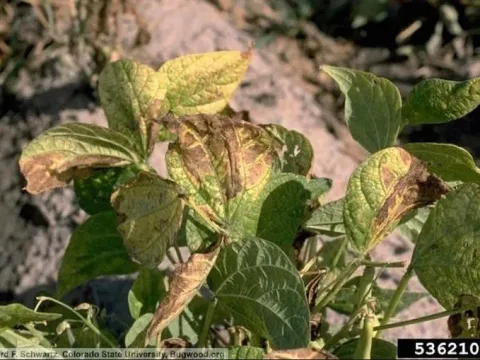
Bean bacterial wilt
Corynebacterium flaccumfaciens
The pathogen, commonly known as Curtobacterium flaccumfaciens (formerly Corynebacterium flaccumfaciens), is a gram-positive, non-spore-forming bacterium belonging to the Actinomycetota phylum. It acts as a vascular plant pathogen.
What the section contains
Bean bacterial wilt
The bacterium is known for its ability to survive for several years in infested soil, plant debris, and internally within seeds. It is a highly specialized parasite that thrives in the plant xylem.
Morphologically, these bacteria appear as small rods and often form yellowish to orange colonies on agar media. They produce specific exopolysaccharides that effectively plug the vascular vessels.
It is classified as a quarantine pest in many regions because it can be easily introduced into new areas via infected seed shipments, potentially causing long-term damage.
Transmission occurs primarily through infected seeds, irrigation water, mechanical tools, and insect vectors that wound the plant tissues during feeding.
The primary host is the common bean (Phaseolus vulgaris), although the pathogen also causes disease in soybeans, peas, and other leguminous species. It is a systemic infection.
Economic damage is significant, as the infection can reduce yield by more than 50% in heavily infested fields. It causes stunted growth, wilting, and often total crop failure.
Infected seeds show reduced germination rates and serve as the main vector for disease dispersal to subsequent crops, threatening both yield quantity and quality.
The disease causes pod deformation and internal rotting, leading to poor seed set. The presence of the pathogen often renders the crop unmarketable due to discoloration and lesions.
Fields with a history of bacterial wilt may be deemed unsuitable for bean production for several years, imposing severe constraints on farmers' land use and crop rotation.
The initial symptom is typically the wilting of leaves during the heat of the day, followed by recovery at night. As the infection progresses, wilting becomes permanent.
Leaf symptoms include marginal chlorosis and the development of necrotic, brown lesions bordered by a distinct yellow halo. This is caused by bacterial toxins affecting photosynthesis.
A hallmark sign of the disease is the browning or darkening of the vascular bundles within the stems. When stems are cut, a sticky bacterial ooze may be visible.
Seedlings may exhibit severe stunting, leaf twisting, or death of the apical meristem. In mature plants, the stem can become hollowed out as tissue decay sets in.
In humid conditions, the pathogen may produce bacterial exudates on the surface of stems and petioles, which can be further spread by wind and rain splash.
Using high-quality, certified pathogen-free seeds is the most effective management strategy. Seed lots must be tested using sensitive molecular methods like PCR.
Implementing strict crop rotation (at least 3–4 years without legumes) helps reduce the soil-borne inoculum level, although the pathogen can persist for long periods.
Integrated pest management (IPM) to control insect vectors is crucial to prevent the mechanical transfer of the bacterium from infected to healthy plants.
Sanitation of farm equipment is essential after operations in infested fields to prevent the spread of the bacteria to clean soil and healthy crops.
While chemical control using copper-based bactericides may provide slight protection, there is no effective cure for an already infected plant, emphasizing the need for prevention.