
Helicotylenchus pseudorobustus
Helicotylenchus pseudorobustus
Description
How to identify
Helicotylenchus pseudorobustus is a species of plant-parasitic nematodes commonly known as spiral nematodes. Belonging to the family Hoplolaimidae, these microscopic worms are widely distributed in agricultural soils, impacting the health of various plant species globally.
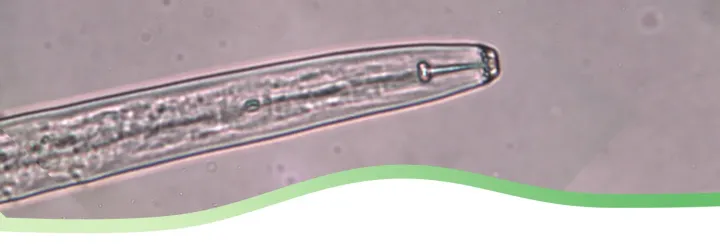
These organisms are ectoparasites, meaning they live and feed primarily outside the roots. They use a sclerotized stylet to puncture root cells and extract nutrients. The "spiral" name comes from the characteristic shape they assume when inactive or fixed in samples.
Taxonomically, they are classified under the phylum Nematoda. Their identification requires specialized laboratory techniques, including morphological examination of the female’s tail, lip region, and stylet length under a high-power microscope, as males are often rare or absent.
The life cycle involves an egg stage, four juvenile stages, and the adult stage. The nematodes move through soil pore spaces to locate susceptible roots. Once a host is found, they may remain in one location for a period while feeding, causing cumulative stress to the plant.
They are highly adaptable and can survive in the soil for significant periods, feeding on a diverse range of hosts, including weeds, which makes them difficult to eradicate through simple crop rotation alone.
##damage##Helicotylenchus pseudorobustus is a polyphagous parasite, meaning it feeds on a wide variety of crops. Significant damage has been reported in cereal crops, maize, soybeans, various vegetable crops, turfgrass, and ornamental nursery stocks across different climatic zones.
By feeding on the root cortex, these nematodes destroy the cells responsible for water and nutrient uptake. This damage is particularly critical during early plant development when the root system is still establishing itself and is highly vulnerable to stress.
The economic impact manifests as reduced vigor, stunted growth, and lower yields. While the damage is rarely lethal on its own, the plants become weakened, making them susceptible to secondary infections by soil-borne pathogens like fungi and bacteria.
The stress caused by nematode feeding mimics nutrient deficiency symptoms or moisture stress. Consequently, farmers often misdiagnose the problem, applying fertilizers or increasing irrigation instead of addressing the underlying nematode population.
In high-density populations, the cumulative effect of root damage significantly reduces the crop's ability to tolerate environmental stresses, such as drought or extreme temperatures, leading to patchy, uneven growth across the field.
Signs of infestation
The primary symptom of infection is generalized poor growth, often appearing in irregular patches throughout the field. Foliage may become chlorotic, and in severe cases, the plants may show signs of premature wilting during dry periods.
Upon inspection of the root system, one might observe browning or necrotic lesions on the roots. Unlike root-knot nematodes, there are no visible galls or swellings, making the presence of Helicotylenchus difficult to detect without expert diagnosis.
Diagnosis requires soil and root analysis performed by a professional laboratory. Experts count the number of nematodes per volume of soil or weight of root tissue to determine if the population density exceeds the threshold for economic damage.
Plants affected by these nematodes often exhibit a reduced root volume and a lack of fine feeder roots. This poor root health is often the hidden cause of unexplained yield loss in high-input farming systems where other factors are supposedly optimized.
Because the symptoms are so non-specific, it is vital to consult with local extension services or plant pathologists if crops consistently underperform despite adequate soil fertility and controlled water management.
Control measures
Integrated Pest Management (IPM) is the best approach for controlling these nematodes. Crop rotation with non-host plants can reduce population levels, although this requires careful planning and knowledge of the specific nematode species present in the field.
Maintaining soil health through the addition of organic matter and proper nutrient management supports robust root development. A healthy plant with a vigorous root system can better withstand the damage caused by nematode feeding compared to stressed plants.
Chemical control via nematicides is an option, but it is typically reserved for high-value crops due to high costs and environmental regulations. Applications must be timed correctly according to regional agricultural guidelines to ensure efficacy.
Sanitation practices are essential to prevent the spread of nematodes to uninfested fields. This includes cleaning farm machinery, tires, and tools after working in infested areas to avoid carrying contaminated soil between different plots of land.
Biological control methods, such as utilizing nematode-suppressive bacteria or fungi, are an area of active research. These solutions offer an eco-friendly alternative to traditional chemicals by creating a soil environment that naturally inhibits nematode growth.
Causes diseases · 2
Discussion
No discussions yet — be the first.