The autumn variety was developed at the Krasnoyarsk Fruit Experiment Station by N. N. Tikhonov and A. S. Tolmacheva from the cross of the early variety Laletno with Papirovka.
The variety is of interest for regions more northern than Krasnoyarsk. It is approved for use in Omsk, Tomsk, Novosibirsk, and Kemerovo regions. It is also grown in Irkutsk region, the republics of Khakassia and Tuva.
The tree is medium-sized and fast-growing. Due to very early fruiting, its growth slows down. The crown is sparse and round; the bark on the trunk is olive-colored, and on thinner upper branches — red. Fruiting occurs on simple and complex buds, partially on last year’s growth.
Shoots of medium thickness, rounded, slightly curved, brownish, more densely hairy at the top than at the bottom. Buds are pressed close, hairy. Leaves are broad, egg-shaped, often rounded, short-pointed, with serrated margins, coarse venation, dark green, buds without hairs. Petioles are medium, thin. Bracts are medium, semicircular.
Flowers are large, white, fragrant, deep-cup-shaped. Petals are oval, translucent. Often, 6 flowers per inflorescence. Stigmas are long, heavily hairy. Stigmas are positioned at the same level as the anthers.
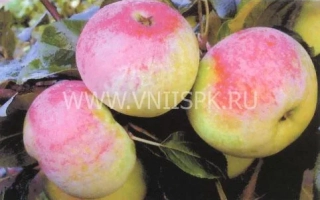
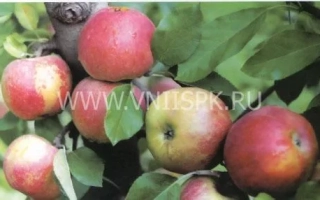
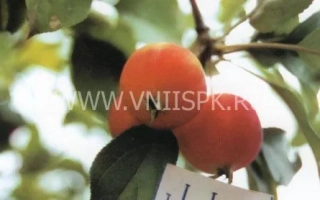
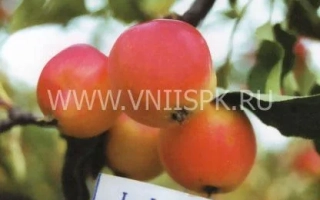
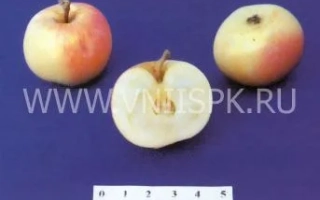
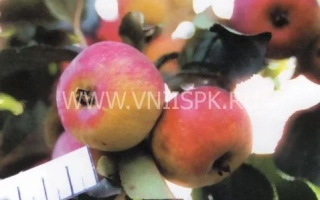
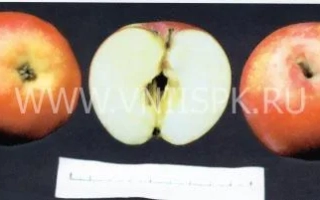
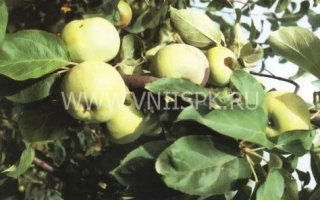
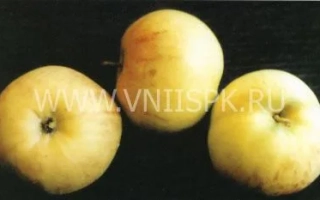
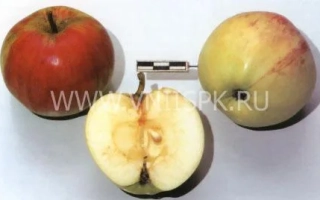
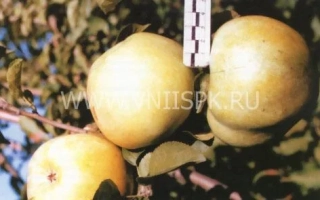
Fruits for semi-cultivation are large, up to 80 g with proper care. Shape is round, sometimes barrel-shaped, slightly ribbed, with a seam. At the time of harvest, the entire fruit is covered with a blurred pink blush, which darkens during storage. Fruit stalks are medium length, thick, in a shallow, often swollen depression without rust. Calyx is small and closed. Receptacle is of medium depth, narrow, ribbed.
Flesh is yellowish, loose, coarse-grained, juicy, tart-sweet, sometimes with astringency in some years.
Chemical composition of fruits: dry matter — 20.3%, sugars — 9.8%, titratable acids — 1.11%, ascorbic acid — 15.4 mg/100g, vitamin P — 232.0 mg/100 g.
Autumn variety. Harvesting from September 5 to 15. Storage life 2–2.5 months (until mid-November). Transportability is good.
Fruits are excellent raw material for purees and juices.
Self-sterile. Best pollinators: Alenushka, Lada, Pepinchk Red Yar.
Early fruiting, high-yielding. Average multi-year yield — 121 centners/ha, maximum — 211 centners/ha. Fruiting is irregular.
Winter-hardy; in harsh winters of the 1960s and 1980s, trees did not lose their crowns. High recovery ability.
Advantages of the variety: winter hardiness, early fruiting, high yield, drought and scab resistance, high fruit technological qualities. Technologists of the Krasnoyarsk Confectionery Factory highly rated the fruit, using it to make candies (Krasnoyarsk Apple).
Disadvantages of the variety: low fruit quality in fresh form.