

SKU #579
·
804 views
Bar-Cot-5
Fungicides
Ф.Суперус Ко ., Лтд., Гонг-Конг, Шанхай, Китай.User rating
0 votes0% positive reviews
No ratings yet — be the first.
Maximum number of treatments
2
Last Processing Date, Days
30
Form of the preparation
Suspension concentrate
Drug Consumption
Up to 0.5 L/ha
About product
A powerful systemic fungicide designed to inhibit fungal cell division and provide long-lasting crop protection.
Maximum number of treatments
2
Last Processing Date, Days
30
Form of the preparation
Suspension concentrate
Drug Consumption
Up to 0.5 L/ha
Description
Mechanism of Action and Chemical Composition
The «Bar-Kot-5» fungicide utilizes carbendazim, a proven compound within the benzimidazole chemical class. Its primary technical advantage lies in the systemic inhibition of pathogen cell division (mitosis). By binding to fungal beta-tubulin, the substance effectively prevents the development of mycelium, making it a powerful tool for controlling latent infections in crops.
Formulation and Application Technology
The product is supplied as a suspension concentrate. This formulation ensures excellent dispersion and stability in the tank mix, promoting uniform coverage and improved resistance to wash-off. The systemic action allows the active ingredient to penetrate the leaf tissue, providing reliable protection against diverse threats including Septoria, Sclerotinia, and snow mold.
Operational Guidelines
Designed for professional field use, the product shows high efficacy when applied according to the following standards:
- Dosage: Up to 0.5 L/ha, providing optimal balance between cost and agricultural impact.
- Application Frequency: Maximum of 2 treatments per growing season.
- Pre-harvest Interval (PHI): 30 days.
With a toxicity profile of class 3, the product is suitable for use on winter wheat, winter barley, sunflower, and fodder beet. Its contact-systemic activity serves as a core component for integrated pest management strategies, ensuring crop longevity and yield protection.
Composition
Active ingredients
- Carbendazim фунгицид Бензимидазолы
Application
Used on crops
Specifications hover over for a hint about the specification
|
Maximum number of treatments
Maximum number of treatments
Maximum recommended number of treatments per vegetation period. |
2 |
|---|---|
|
Last Processing Date, Days
Last Processing Date, Days
Number of days from processing to harvest cleanup |
30 |
| Form of the preparation | |
|
Drug Consumption
Drug Consumption
Mass of the preparation per unit of treated area. It is customary to express the dosage rate in kilograms per hectare. The dosage rate is most often given in terms of 100% active ingredient, although sometimes it is calculated based on the preparation in the form of application w... |
Up to 0.5 L/ha |
|
Type of Action
Type of Action
Insecticides are divided into contact, systemic, stomach, and fumigants based on their mode of entry into the organism. Contact insecticides affect insects upon contact with any part of their body, penetrating into their organism through the integument. They are used against pest... |
|
| Danger Class | 3 |
| Registration year | 2011 |
| Catalog | Catalog → Fungicides |
| Manufacturer | Ф.Суперус Ко ., Лтд., Гонг-Конг, Шанхай, Китай. |
| Legal data |
Show · 1
|
| Country | China |
Store offers
Prices are updated on loadLoading offers…
Aggregator catalog: prices are collected automatically from store websites, normalized by AI and converted at the current exchange rate. Before ordering, confirm the price and availability on the store's website. This block is not indexed by search engines — the data is loaded after the page opens.
Not yet комментариев. Be the first!
Alternatives
Fungicides · similar preparations



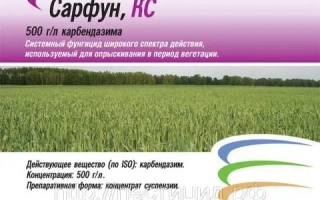
Sarfun 500 SC
Хімічні заводи «Органіка-Сажина»С.А., Нова Сажина, Польща
01.2K 1 offer
26.74 €per 1 l ≈ 1 381 ₴



See also
Often considered together with this product





Recently viewed
Products you’ve viewed on this site
Reviews · 0