

SKU #73748
·
76 views
ESTI NARIS
Fodder Turnip
User rating
0 votes0% positive reviews
No ratings yet — be the first.
Ripening Period
50–60
Skin Color
Purple with White
Meat Color
White
Root vegetable shape
Round
Prices in stores
from0.22 €per 1000 seeds
pack from 0.11 € per 500 pcs
2 offers from 2 stores
Store offers · 2 from 2 stores
Prices are updated on loadLoading offers…
Available at: 1semena · Геліос · Urozhaynyj Ogorod
Aggregator catalog: prices are collected automatically from store websites, normalized by AI and converted at the current exchange rate. Before ordering, confirm the price and availability on the store's website. This block is not indexed by search engines — the data is loaded after the page opens.
About product

ESTI NARIS – an early-maturing turnip (Brassica rapa L., var. rapa) variety that reaches technical maturity of its root crops within 50–60 days from germination. The plant leaves are simple, light green, hairy, and free of a waxy bloom, which facilitates care and increases resistance to diseases. The root crop has an oval shape with a smooth surface: a white underground part and a purple upper col…
Ripening Period
50–60
Skin Color
Purple with White
Meat Color
White
Root vegetable shape
Round
Description
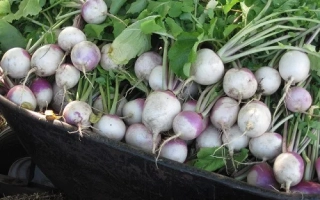
ESTI NARIS – an early-maturing turnip (Brassica rapa L., var. rapa) variety that reaches technical maturity of its root crops within 50–60 days from germination. The plant leaves are simple, light green, hairy, and free of a waxy bloom, which facilitates care and increases resistance to diseases. The root crop has an oval shape with a smooth surface: a white underground part and a purple upper coloration; the flesh is dense, juicy, and white. The mass of one root crop is typically 300–400 grams, with a yield of 6 to 8 kilograms per square meter.
The variety is distinguished by high marketability and storability, making it attractive for both commercial cultivation and home consumption. ESTI NARIS grows well in open ground, especially on light loamy and sandy soils with moderate moisture, as well as on clay loam substrates rich in humus. Moisture is a key factor: turnips are moisture-loving but cannot withstand drought and high temperatures; seeds germinate at 2–3 °C, and seedlings withstand frosts down to –5 °C.
For successful cultivation, deep autumn plowing and careful spring soil treatment are recommended. Sowing is done with row spacing of 45–70 cm, at a depth of 1.5–2.5 cm, and a sowing rate of 1 to 2.5 kg/ha. Optimal plant density is 80–100 thousand per hectare. Care and fertilization are similar to methods used for growing rutabaga. The ESTI NARIS variety is suitable for crop rotation near livestock farms, as well as as a predecessor for cereals, legumes, and silage crops.
The variety is distinguished by high marketability and storability, making it attractive for both commercial cultivation and home consumption. ESTI NARIS grows well in open ground, especially on light loamy and sandy soils with moderate moisture, as well as on clay loam substrates rich in humus. Moisture is a key factor: turnips are moisture-loving but cannot withstand drought and high temperatures; seeds germinate at 2–3 °C, and seedlings withstand frosts down to –5 °C.
For successful cultivation, deep autumn plowing and careful spring soil treatment are recommended. Sowing is done with row spacing of 45–70 cm, at a depth of 1.5–2.5 cm, and a sowing rate of 1 to 2.5 kg/ha. Optimal plant density is 80–100 thousand per hectare. Care and fertilization are similar to methods used for growing rutabaga. The ESTI NARIS variety is suitable for crop rotation near livestock farms, as well as as a predecessor for cereals, legumes, and silage crops.
Specifications hover over for a hint about the specification
|
Ripening Period
Ripening Period
It takes 70-100 days until pepper reaches flowering stage, 130-160 days until technical fruit ripeness, and 135-180 days until physiological ripeness. |
50–60 |
|---|---|
| Skin Color | |
| Meat Color | |
| Root vegetable shape | |
| Average root crop weight (g) | 250–400 |
| Registration year | 1952 |
| Catalog | Catalog → Fodder Turnip |
| Legal data |
Show · 1 |
| Country | Russia |
Not yet комментариев. Be the first!
Alternatives
Fodder Turnip · similar varieties

See also
Often considered together with this variety



Recently viewed
Products you’ve viewed on this site
Reviews · 0