


SKU #4593
·
372 views
Currant Trilena (Alenushka, Chudo)
Currant
Type of Variety
Blackcurrant
Your mark
0 votes
0% positive ratings
Store offers · 1 from 1 store
1 offer in 1 store — from 6.3 € per seedling.
Available at: Цветы для дома
Prices are collected automatically from store websites and converted at the current exchange rate. Check the price and availability on the store website before ordering.
Description
Medium-maturing variety, developed at Pavlovsk Experimental Station of the All-Union Institute of Plant Industry named after N.I. Vavilov from crossing the varieties Minay Shmyrev and Ojebyn. Authors: E.V. Volodina, S.P. Хотимская, O.A. Tikhonova. Included in the State Register of Varieties since 1995, approved for use in the Northwestern region.
The bush is fairly tall, moderately spreading, and sparse. Growing shoots are of medium thickness, straight, weakly unevenly colored, smooth, and hairless. Woody shoots are thick and medium-sized, gray-brown or nearly beige, with a brown tip, straight or slightly curved, smooth, and weakly hairy. Buds are single, small, egg-shaped with a pointed apex, asymmetrical, pink, arranged parallel to the shoot, pressed against it, hairy. Terminal bud is non-free (with two adjacent smaller buds), large, cylindrical with a blunt apex, hairy. Leaf scars are wedge-shaped and wedge-shaped with a drawn-out apex.
Leaf is five-lobed, medium-sized, green with slight yellowing, weakly glossy, wrinkled, medium density, weakly hairy along the veins on both upper and lower leaf surfaces. In the area of the petiole notch — with denser, light woolly hairs. Leaf blade is nearly straight or slightly concave along main veins. Leaf veins are predominantly uncolored. Central lobe is egg-shaped with a pointed apex, slightly elongated, slightly larger and longer than lateral lobes, additional protrusions are weakly expressed, often only on one side. Lateral lobes are narrow, triangular or egg-shaped, with apexes spreading sideways and veins directed at an obtuse angle. Basal lobes are clearly defined, their veins spread out or directed toward the petiole. Base of leaf has an open, triangular, medium-depth notch. Teeth are wide, blunt, large-glandular or double-glandular, medium-depth, with a clearly visible "claw". Petiole is medium and long, thick, hairy, colored more often at the base of the petiole or at the base of the leaf, or on some shoots along the entire length, directed toward the shoot at an acute angle.
Flowers are medium and small, cup-shaped, with an expanded base, pinkish. Sepals are oval, pinkish, hairy, twisted, free. Petals are oval and egg-shaped, pointed, uncolored, nearly closed. Stigma is at the same level as stamens or slightly lower. Ovule is hairy, with glands, with anthocyanin coloring in the form of "tan" on the lower part of the flower tube, or "tan" is preserved only on one side of the ovule. Inflorescences are medium (5.9 cm, 6-9 berries), stem of medium thickness, with even berry distribution, more densely hairy in the middle and upper parts, green with "tan". Petiole of inflorescence is medium, pedicels are fairly thick and short, hairy, bluish-green.
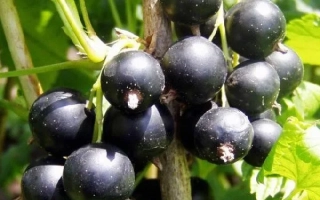
Berries are medium to large (0.9-1.1 g), uniform, round, black, glossy, smooth, with medium number of seeds (33), dry detachment. Occasionally, small "folds" are visible on larger berries, radiating from the berry base. Calyx is medium, closed, falling and semi-falling. Taste is sour (4.2 points), berries are of universal use. Chemical composition: dry solids — 22.3%, total sugars — 12.9%, titratable acidity — 2.7%, ascorbic acid — 174.2 mg/100 g.
Variety is highly winter-hardy, highly self-fertile (52.5%), early-bearing, resistant to powdery mildew and leaf spot diseases, shows moderate resistance to bud mite, consistently high-yielding (1.8-2.4 kg/bush).
Advantages of the variety: resistance to fungal diseases, high winter-hardiness, which ensures high productivity even after severe winters or winters with sharp temperature fluctuations; high self-fertility, early bearing, high dry matter content in fruits, dry berry detachment.
Disadvantages of the variety: medium berry size, sour taste.
Crop & resistance
Crop
Disease resistance
Pest resistance
Specifications
| Type of Variety | |
|---|---|
| Catalog | Catalog → Currant |
No reviews yet. Be the first to share your experience.
Alternatives
Currant saplings · similar varieties



See also
Often considered together with this variety


Recently viewed
Products you’ve viewed on this site
Reviews