
Mixed mandi prices leave India's rabi farmers with uneven returns
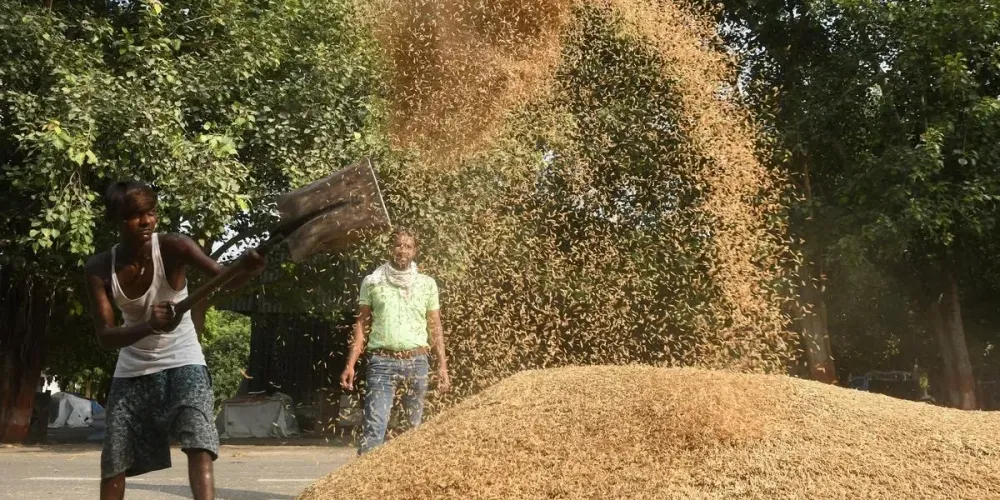
Prices for India's main rabi crops are sending mixed signals to farmers in the middle of the harvest season. Data cited by The Hindu BusinessLine from the Agmarknet portal show that from April through the end of June, mandi prices for two of the five key rabi crops were running 4 to 5 percent below their minimum support prices, while three others were trading above the government benchmark by as much as 14 percent.
In cereals, the all India average farm-gate wheat price on May 22 stood at 2,456 rupees per quintal, 5 percent below the MSP of 2,585 rupees. Barley was stronger at an average 2,198 rupees per quintal against an MSP of 2,150 rupees, or about 2 percent higher. The report also highlighted maize, which is grown in the rabi season as well, at 1,896 rupees per quintal, 21 percent below its MSP of 2,400 rupees.
In pulses, chana averaged 5,656 rupees per quintal, around 4 percent below its MSP of 5,875 rupees. Masur was slightly above support at 7,045 rupees against an MSP of 7,000. Mustard, the main oilseed of the season, posted the strongest premium, averaging 7,081 rupees per quintal, which is 14 percent above its MSP of 6,200 rupees.
A government source told the paper that prices up to 5 percent below MSP should be viewed as normal market behaviour and not an automatic trigger for intervention. The official argument is that demand and supply should be allowed to correct crop-specific surpluses because procurement under the official system creates its own disposal and storage problems. At the same time, the government raised its 2025-26 wheat production estimate to a record 120.21 million tonnes from 117.51 million tonnes a year earlier, and also lifted output estimates for rapeseed and mustard, chana and masur.
D K Pant, chief economist at India Ratings and Research, said current prices reflect domestic stock positions and internal demand. In his view, mustard growers are clear winners while maize farmers are the obvious losers. With retail food inflation rising to 4.2 percent in April from 3.87 percent in March and overall retail inflation reaching 3.48 percent, the pricing pattern in rabi markets is becoming an important test of how well farm incomes can hold up under broader cost pressure.
Not yet comments. Be the first!
Comments · 0