
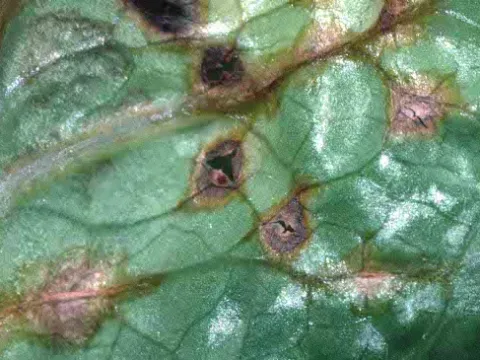
Lettuce ring necrosis
Lettuce ring
Lettuce ring necrosis is caused by the Lettuce ring necrosis virus (LRNV). It is a soil-borne virus that poses a significant threat to lettuce cultivation.
What the section contains
Lettuce ring necrosis
The virus can persist for long periods in soil particles and the root systems of various weed species. This makes the soil an active reservoir for the pathogen.
Transmission occurs through the contact of crop roots with infested soil. Once the virus enters the plant, it spreads systematically through the vascular tissues.
A key biological aspect is the virus's ability to survive within the spores of soil-borne fungi, which act as vectors. This ecological adaptation allows the virus to survive even in the absence of a host.
Accurate identification of the pathogen usually requires advanced molecular testing, as symptoms often overlap with common nutrient deficiencies or fungal root rots.
The initial sign of the disease is the development of chlorotic rings on the leaves. These often appear as concentric circles or intricate, wavy patterns.
As the infection progresses, necrotic spots develop within the ring patterns. The leaves become deformed, lose turgor, and take on a yellowish-brown, unthrifty appearance.
Symptoms typically manifest on older leaves first, gradually moving to younger, developing foliage, which leads to stunted growth and failure to form a head.
Root systems may appear weakened, though specific underground symptoms are often subtle compared to those seen on the foliage.
- Yellowing of leaf margins
- Concentric ring patterns on leaves
- Stunting of the entire head
- Tissue necrosis within spots
High soil moisture combined with cool-to-moderate temperatures provides the most favorable conditions for disease development. Peaks are often seen in spring and autumn.
Poor soil structure and compaction encourage the spread of the virus through root systems. Maintaining good soil aeration is essential for reducing infection rates.
The presence of weed reservoirs is a critical factor for the persistence of the virus in a field. Many weeds serve as asymptomatic hosts throughout the season.
Greenhouse environments with closed irrigation systems are particularly prone to outbreaks if water sources or soil are not properly sanitized.
Short crop rotation cycles, where lettuce is planted on the same field too frequently, create conditions that allow the virus population to build up significantly.
Lettuce ring necrosis causes substantial economic losses, as infected plants are generally unmarketable due to their unsightly appearance and poor quality.
The disease leads to a marked reduction in yield. Infected lettuce plants rarely reach full maturity, resulting in significant weight loss at harvest.
The virus degrades the sensory quality of the leaves, making them bitter and tough, which makes the product unacceptable for fresh market consumers.
Once a field is infested, the virus can persist for several years, potentially forcing farmers to switch to non-susceptible crops or invest in costly soil treatment.
Indirect losses include increased labor costs for sanitation and the disruption of carefully planned production schedules.
Implementing a strict crop rotation strategy is the most effective cultural control method. Avoiding susceptible crops in the rotation helps break the virus cycle.
Rigorous weed management is necessary, both within the field and in the surrounding areas, to eliminate potential reservoirs of the virus.
Utilizing resistant or tolerant lettuce varieties is the best long-term prevention strategy. Breeders continue to work on improving resistance to this soil-borne pathogen.
If an outbreak is detected, roguing infected plants promptly, including the surrounding soil, can help limit the spread of the pathogen to adjacent healthy plants.
In greenhouses, soil steam sterilization or chemical fumigation can be employed to eliminate the viral reservoir in the substrate before planting.