
Melon mosaic virus
Carlavirus melonis
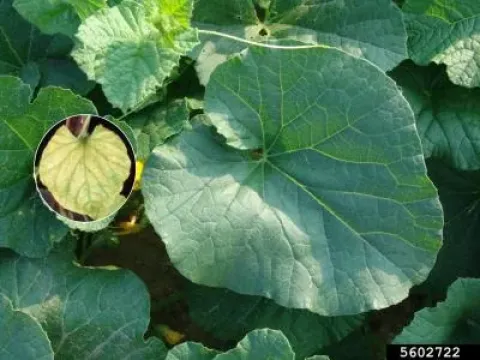
The primary symptoms of the disease appear as chlorotic mottling or mosaic patterns on the leaf surface. As the infection progresses, leaves may become curled, distorted, and stunted, while internodes on the vines become shortened, giving the plant a bushy or stunted appearance.
What the section contains
Melon mosaic virus
Fruits infected with the virus often show signs of malformation, including bumps, ridges, or irregular green spots. The quality of the flesh is severely compromised, often resulting in lower sugar content, watery texture, and smaller overall size compared to healthy specimens.
Early-stage symptoms may manifest as faint yellowing along the leaf veins, which can be easily missed. If the virus continues to multiply, necrotic spots may develop, leading to premature yellowing and eventual death of the affected leaves, significantly reducing the photosynthetic area.
The severity of the symptoms is heavily dependent on the plant's growth stage when the infection occurs. Seedlings infected early in the season are particularly vulnerable and often fail to thrive or produce any marketable fruit, leading to total yield loss for those specific plants.
Because visual signs can sometimes mimic nutrient deficiencies or chemical phytotoxicity, professional diagnosis is recommended. Confirming the presence of the virus is essential to ensure that farmers do not waste resources treating the wrong problem.
The causal agent is the Melon mosaic virus, which is classified within the Carlavirus genus. It is a highly efficient obligate parasite that exploits the host plant's internal cellular machinery for its own replication, causing systemic infection.
The virus cannot exist outside of living host tissues. Once it enters the vascular system of the melon plant, it travels rapidly through the phloem to all parts of the plant, including stems, leaves, and developing fruit, effectively turning the plant into a viral reservoir.
The primary mode of transmission is via mechanical vectors, specifically aphids. When an aphid feeds on an infected plant, it picks up viral particles and transmits them to healthy plants during subsequent feeding sessions, allowing the virus to spread rapidly across fields.
In addition to insect vectors, the virus can persist in perennial weeds, which act as reservoirs during the off-season. It can also be spread through contaminated pruning tools or during agricultural operations if healthy plants are wounded by equipment that has touched infected material.
The viral genome consists of a single-stranded RNA molecule wrapped in a helical capsid. This structural stability allows the virus to remain infectious within its host for long periods, complicating management efforts in open-field agriculture.
Disease spread is most rapid during periods of high vector activity, typically in warm, dry weather. These conditions facilitate the exponential growth of aphid populations, which are the main carriers responsible for the rapid movement of the virus through the plantation.
Temperature plays a crucial role in viral replication; temperatures ranging between +25 and +30 degrees Celsius are often optimal for the virus. While warm weather supports fast vine growth, it also accelerates the systemic spread of the virus within the plant tissues.
The presence of wild host plants, particularly weeds in the Cucurbitaceae and Solanaceae families, acts as a primary source of inoculum. If these weeds are not properly managed, they serve as a bridge for the virus to move from one crop season to the next.
Limited spatial isolation between older, infested melon fields and new plantings creates a high-risk environment. Aphids and other insects move easily between nearby fields, ensuring that the virus remains active and present in the agricultural area.
Stressful conditions, such as drought, poor soil fertility, or extreme temperature fluctuations, make plants more susceptible to viral infections. Healthy, well-nourished plants tend to have a slightly better chance of tolerating the infection compared to stressed ones.
The most significant danger is the lack of curative treatments. Once a plant is systemically infected with a virus, it cannot be cured, and it serves as a constant source of inoculum that threatens the health of all neighboring plants.
Economic impact is primarily driven by the significant reduction in fruit marketability. Infected melons often fail to meet aesthetic standards, have reduced shelf life, and exhibit poor flavor profiles, leading to substantial financial losses for the grower.
Viral infection disrupts the plant's overall development, leading to early senescence and reduced fruit set. Consequently, total yield volume decreases significantly, forcing farmers to bear the costs of cultivation for a crop that fails to meet production targets.
Long-term persistence in the environment or in weed hosts can force growers to rotate away from cucurbit crops entirely for several years. This restriction of land use impacts the overall economic strategy of the farm and complicates crop rotation planning.
In regions where the virus is endemic, the cost of continuous pest control and the risk of yield loss can make melon production unsustainable without significant investment in resistant varieties and strict phytosanitary measures.
The most effective strategy involves comprehensive vector control. Managing aphid populations using timely insecticide applications is essential to reduce the transmission rate of the virus throughout the field.
- Use only certified, virus-free seeds and transplants for planting.
- Implement rigorous weed control programs to eliminate host reservoirs.
- Maintain adequate spatial distance between older crops and new plantings.
- Disinfect agricultural tools regularly to prevent mechanical transmission.
- Prioritize the use of resistant or tolerant hybrid varieties in high-risk areas.
Consistent monitoring of the fields is critical. If plants exhibit clear symptoms of mosaic disease, they should be immediately uprooted, removed from the field, and destroyed to prevent the further spread of the virus to healthy plants.
Adopting good agricultural practices, such as proper fertilization and irrigation, strengthens plant vigor and can help minimize the impact of the disease. Furthermore, the use of physical barriers or reflective mulches may help deter insect vectors from settling on the crop.
An integrated approach that combines chemical pest control, physical barriers, and sound field hygiene is the best way to keep the virus in check. Prevention remains the only viable strategy in the absence of treatments for established viral infections.