
Benyvirus
Benyvirus
The genus Benyvirus consists of plant viruses with a unique multipartite genome composed of several segments of single-stranded RNA. The most economically significant species is the Beet necrotic yellow vein virus (BNYVV).
What the section contains
Benyvirus
The virus particles have a distinct rod-like morphology of varying lengths. This characteristic structure is a key taxonomic marker used in laboratory diagnostics to identify members of this specific genus.
A fundamental biological trait of Benyvirus is that it is not transmitted by mechanical contact or common insect vectors. Instead, it relies on a specific biological vector present in the soil environment.
The vector is Polymyxa betae, an obligate soil-borne parasite belonging to the Plasmodiophoromycetes group. This fungus-like organism carries the virus within its zoospores, enabling infection of the host plant roots.
The virus exhibits remarkable stability. It can persist in the resting spores (cystosori) of its vector for over a decade, making it extremely difficult to eradicate from infested agricultural fields.
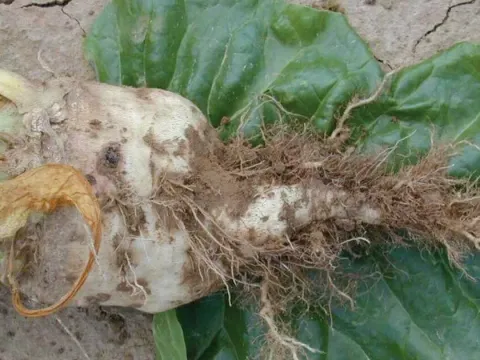
The most distinctive symptom of Benyvirus infection is rhizomania, which manifests as excessive proliferation of lateral rootlets. This creates a thick, bushy appearance of the root system, often called "hairy root".
Above-ground symptoms include foliar chlorosis, often appearing as yellowing of the leaf veins or a mosaic pattern. Leaves may appear smaller than normal and show signs of severe stunting during the growing season.
When infected taproots are cut, the vascular bundles often appear darkened or necrotic. This internal damage is a sign that the virus has severely disrupted the nutrient transport mechanisms of the plant.
In the field, plants often appear in patches. They exhibit poor growth, wilting during periods of heat, and significant biomass loss compared to healthy plants in the surrounding area.
- Proliferation of fine lateral roots (hairy root).
- Chlorotic yellowing of leaf veins.
- Stunted growth and leaf deformation.
- Vascular browning and necrosis in taproots.
- Premature wilting in hot conditions.
The disease development is heavily dependent on soil moisture. High levels of soil water facilitate the movement of Polymyxa betae zoospores, allowing them to locate and infect host roots effectively.
Optimal conditions for infection occur at soil temperatures between +20 and +25 degrees Celsius. These temperatures maximize the activity of both the viral replication and the vector's reproductive cycle.
Soil structure plays a critical role in disease spread. Heavy, poorly drained clay soils are more prone to infection outbreaks because they retain the moisture necessary for vector survival and mobility.
Continuous cropping of host plants on the same field leads to the accumulation of high levels of viral inoculum. Because of its longevity, the virus remains a threat for many years after the last host crop.
Anthropogenic factors are the primary cause of long-distance spread. Infested soil stuck to tractors, plows, and other farming equipment serves as a vehicle for moving the virus between farms.
Benyviruses cause rhizomania, which is one of the most devastating diseases in sugar beet production worldwide, often resulting in significant yield losses, sometimes reaching up to 80% in susceptible varieties.
Beyond the loss of root mass, the quality of the sugar beet is severely compromised. A dramatic drop in sugar content (sucrose) occurs, making the crop non-viable for industrial sugar extraction.
The disrupted vascular system and internal necrosis make infected roots highly susceptible to storage rots, causing further losses after harvest and during processing in storage facilities.
Economic impact is severe, encompassing reduced yield, lowered product quality, and the high cost of implementing long-term management strategies for infested land.
Fields with high levels of infestation often become unfit for standard sugar beet production, forcing farmers to seek alternative, often less profitable, crop options.
The primary and most effective method of control is the use of genetically resistant or tolerant hybrids. Breeding programs focusing on rhizomania resistance have been the cornerstone of modern management.
Strict phytosanitary practices are essential, particularly cleaning machinery and equipment thoroughly to remove soil before moving from an infested site to uninfested areas.
Improving soil drainage through tile drainage or soil structure management can reduce the environmental suitability for the vector, thereby limiting the success rate of viral transmission.
While crop rotation is limited in its ability to eliminate the virus due to the longevity of the vector spores, it remains a helpful practice to reduce the overall inoculum density over long periods.
Integrated disease management (IDM) that combines resistant varieties, hygiene, and optimized soil conditions is necessary to maintain productivity in regions where the virus is present.