
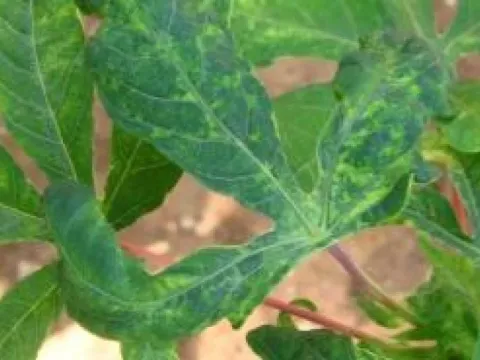
African cassava mosaic
Begomovirus manihotis
The disease is caused by a complex of viruses within the genus Begomovirus, family Geminiviridae. These are small, single-stranded DNA viruses.
What the section contains
African cassava mosaic
The primary vector for the transmission of this virus is the whitefly Bemisia tabaci. The insect acquires the virus while feeding on infected plant sap.
Transmission also occurs through vegetative propagation. Using infected cuttings as planting material is a major cause of the disease spreading over long distances.
The virus strictly targets the cassava plant Manihot esculenta, causing systemic infection throughout the entire plant tissue.
Once infected, the virus interferes with the host's genetic expression, resulting in permanent damage that cannot be cured by chemicals or pesticides.
Symptoms typically begin with a characteristic mosaic pattern on the leaves, featuring alternating patches of green and yellow or white.
The leaves exhibit severe deformation, including curling, crinkling, and a reduction in size. They may also become twisted or misshapen.
Stunting of the entire plant is common, as the virus shortens internodes, leading to a bushy and reduced growth habit compared to healthy plants.
Storage root production is heavily impacted; the tubers are usually fewer in number and significantly smaller in size than those of healthy cassava.
- Chlorotic mosaic patterns on leaves.
- Severe leaf curling and crinkling.
- Stunted plant height.
- Reduced size of storage tubers.
- Poor yield quality and quantity.
The development of the disease is highly dependent on environmental factors that influence the population dynamics of the whitefly vector.
Warm, dry weather conditions provide an ideal environment for whitefly proliferation, significantly increasing the rate of viral spread.
Poor agricultural practices, such as failing to remove infected volunteer plants, ensure a constant reservoir for the virus within the field.
The lack of crop rotation and the continuous planting of susceptible cassava varieties in the same area perpetuate the disease cycle.
Regional climate patterns that allow for year-round whitefly survival create a perpetual high-risk zone for the spread of this mosaic virus.
African cassava mosaic is considered the most significant constraint to cassava production in many sub-Saharan African countries.
Yield losses can reach 90 percent in severe cases, which poses a massive threat to food security for communities dependent on this crop.
The economic damage is exacerbated by the fact that infected plants become unusable for future propagation, creating a cycle of poverty for farmers.
Reduced tuber starch content makes the produce less valuable both for direct human consumption and for industrial processing into flour or starch.
The cumulative loss from this disease affects millions of farmers, leading to significant instability in regional agricultural markets.
The most sustainable method for controlling African cassava mosaic is the deployment and widespread use of virus-resistant cassava varieties.
Implementing strict phytosanitary measures, including the use of certified healthy cuttings, is essential for starting a clean crop cycle.
Integrated Pest Management (IPM) focusing on controlling whitefly populations can reduce the spread, though it is often difficult to implement.
Rogueing, or the prompt removal and destruction of symptomatic plants, helps limit the inoculum source within new and existing plantations.
Public awareness programs are crucial to ensure that farmers understand the importance of planting disease-free material and identifying early infection signs.