
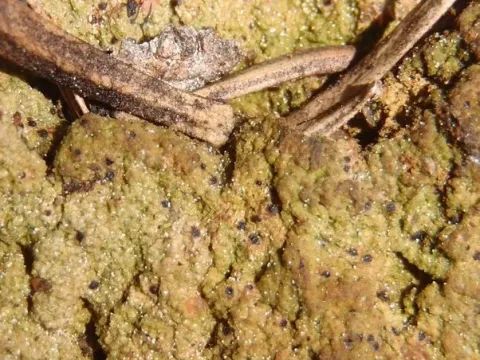
Thrombium epigaeum
Thrombium epigaeum
Thrombium epigaeum is a soil-inhabiting lichen, a symbiotic organism composed of a fungus and an alga. In agricultural practice, it is often confused with fungal diseases due to its appearance.
What the section contains
Thrombium epigaeum
However, it is not a plant pathogen. It does not infect crops, roots, or foliage, and it does not derive nutrients from agricultural plants, making it harmless to commercial crop yields.
Biologically, it is a pioneer species that thrives on bare mineral substrates where moisture is abundant and competition from higher plants is minimal or absent.
The organism does not produce mycotoxins or harmful enzymes that affect soil fertility or plant development, as its existence is confined to the very surface of the soil.
Therefore, it should not be categorized as a disease of crops, but rather as an indicator of specific environmental conditions within the field that may require attention.
The primary symptom of Thrombium epigaeum presence is the emergence of grey-brown or greenish specks on the soil surface, which may eventually coalesce into a continuous, crust-like patch.
When the soil is damp, these structures become more visible and gain a richer color, which often leads farmers to mistake them for mold or moss-related pathogens.
In dry conditions, the lichen appears as a brittle, dry crust that can be easily disturbed or broken down by standard mechanical soil cultivation processes.
These patches are typically found in shaded or poorly drained parts of the field where the soil surface remains moist for extended periods after rain or irrigation.
An essential diagnostic feature is the lack of any physical damage to nearby crops; the lichen remains strictly localized on the soil surface and does not climb or parasitize plants.
Development of this lichen is favored by bare soil surfaces, lack of regular tillage, and consistently high humidity levels at the soil-air interface.
It is most frequently observed in abandoned or unworked fields, or in areas with soil compaction where vegetative competition is weak, allowing the lichen to establish itself.
The organism shows strong tolerance to temperature fluctuations, enabling it to persist and reproduce even in cool, temperate climates during the active growing season.
Neutral soil pH levels are optimal for its colonization, making it relatively common in fertile loam or clay soils that have been left undisturbed for significant periods.
Poor water management, such as puddling or lack of proper drainage, creates an ideal environment for Thrombium epigaeum to colonize large surface areas.
There is no direct economic or agronomic harm caused by Thrombium epigaeum, as it does not compete with crops for nutrients or water in the root zone.
The indirect risk lies in the formation of a surface crust, which can impede initial aeration and seedling emergence if the colonization becomes extensive enough to cover large patches of soil.
More importantly, the presence of this lichen serves as a clear indicator of suboptimal field management, such as long-term fallow periods or neglect of basic cultivation techniques.
While the lichen itself is harmless, its dominance on a field suggests that the soil is not being utilized to its full productive potential, which is the primary concern for agronomists.
There are no recorded instances where Thrombium epigaeum led to yield losses, provided that proper standard agricultural practices are maintained throughout the season.
The most effective management strategy is regular mechanical soil cultivation, including plowing, disking, or harrowing, which destroys the surface layer and disrupts the lichen's structure.
Prevention focuses on maintaining high-density crop stands or using cover crops to minimize the area of bare soil, effectively depriving the lichen of its required habitat.
Improving field drainage to prevent waterlogging is a key preventive measure, as it eliminates the high-moisture conditions the organism needs to thrive.
- Implement deep plowing or disking before sowing.
- Use cover crops (green manure) to prevent bare soil.
- Maintain consistent crop rotation cycles.
- Ensure adequate soil aeration through mechanical tillage.
Chemical control using fungicides is neither necessary nor recommended, as the cost-benefit ratio is negative due to the non-pathogenic nature of the organism.