
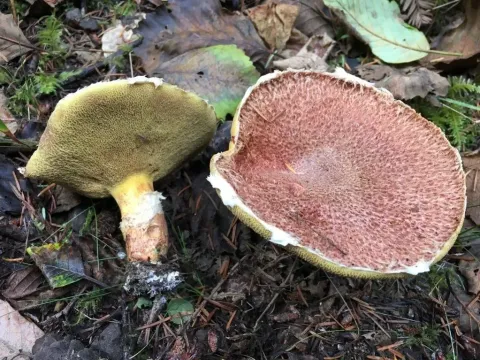
Lake's slippery jack
Suillus lakei
Lake's slippery jack (Suillus lakei) is a basidiomycete fungus belonging to the Suillaceae family, widely known for its mycorrhizal association with conifer trees.
What the section contains
Lake's slippery jack
This organism is not a plant pathogen; it functions as a symbiotic partner that forms ectomycorrhizae on the roots of various coniferous species, particularly larch.
The fungus provides the host tree with essential minerals and water, while the tree supplies the fungus with photosynthetic sugars, creating a mutualistic relationship.
Its biological structure consists of a cap with a characteristic reddish or brownish scaly surface, which helps distinguish it from other members of the genus.
Scientific literature classifies it as a beneficial fungus that supports tree growth rather than causing disease or structural damage to the plants.
Suillus lakei thrives in environments where host trees, especially the larch, are present, as the root exudates are essential for the germination of its spores.
The fungus prefers moist, well-drained soils rich in organic matter, which provide the necessary substrates for mycelial expansion and the formation of fruiting bodies.
Ideal conditions for growth involve moderate soil temperatures and high relative humidity, which are typically found in forest ecosystems during the autumn season.
Spores are dispersed via wind or water runoff, establishing new colonies in the rhizosphere of compatible hosts after successful interaction with the root system.
Environmental stability is key; sudden shifts in soil pH or extreme moisture variations can limit the activity of the fungal mycelium in forest habitats.
This fungus does not cause infections, necrotic lesions, or rotting in trees, making it non-hazardous to plant health in forestry and arboriculture contexts.
Potential negative impact is limited to nursery settings, where vigorous mycelial growth can create a dense network, potentially complicating the lifting of seedlings.
It does not act as a primary agent of plant decline; rather, it is frequently found associated with healthy, thriving trees due to the benefits of the mycorrhizal bond.
In cases of existing root damage from other factors, the fungus may colonize the area, but this is an opportunistic behavior rather than a pathological attack.
Economic damage caused by Suillus lakei is non-existent, and it is rarely documented as an issue requiring intervention by plant pathologists.
No chemical control measures are recommended or necessary for Suillus lakei, as it is considered a beneficial component of the forest ecosystem.
In forest nurseries, proper sanitation practices during seedling harvest are sufficient to manage any issues related to the physical presence of the mycelium.
Avoiding the overuse of synthetic fertilizers that might disrupt the natural mycorrhizal flora is recommended to maintain a balanced soil microbiome.
Integrated forest management emphasizes keeping host trees healthy, which indirectly maintains the population of beneficial fungi like Suillus lakei.
Monitoring the growth of seedlings is standard practice, but no specific intervention is required to address this fungus as it provides more benefits than harms.