
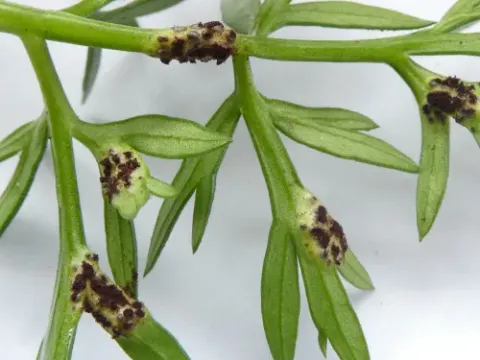
Physoderma pulposum
Physoderma pulposum
Physoderma pulposum infection manifests as the formation of characteristic galls or swellings on the affected organs of the host plant.
What the section contains
Physoderma pulposum
Externally, these growths appear as numerous small bumps that develop on the petioles, leaves, and stems of goosefoot (Chenopodium).
Inside the galls, fungal spores eventually form, leading to discoloration of the affected plant tissues, typically turning them pale or yellowish.
In cases of severe infection, the affected parts of the plant become deformed, which negatively impacts the overall physiological state of the weed.
Visual diagnosis is difficult during early stages, but careful inspection reveals a characteristic bumpiness on the leaf surface.
The causal agent of this disease is the chytrid fungus Physoderma pulposum, which belongs to the order Chytridiales.
This pathogen acts as an obligate parasite closely associated with tissues of plants in the Amaranthaceae family, particularly the genus Chenopodium.
The biological cycle of the fungus includes the formation of zoospores that can move through an aquatic environment to infect new parts of the plant.
During its life cycle, the pathogen triggers hypertrophy in plant tissues, which leads to the formation of the characteristic galls.
The fungus survives in the soil and on plant debris in the form of resting spores, which possess high resistance to unfavorable environmental conditions.
The development of Physoderma pulposum directly depends on the moisture level of the soil and the surface air layer, as zoospores require free water for movement.
The most favorable periods for infection are those with prolonged rainfall or excessive irrigation during the spring and summer.
Temperature plays a secondary role, although moderately warm conditions accelerate spore germination and increase the pathogen's activity.
High plant density facilitates the rapid spread of the infection from an infected plant to a healthy one when contact occurs.
The accumulation of inoculum in the agrocenosis is promoted by the lack of crop rotation and the practice of leaving infected plant debris on the soil surface.
The primary harmfulness of Physoderma pulposum lies in suppressing the growth and development of the weed, which competes with agricultural crops.
Although this is a disease of a weed, it is not an effective method of biological control because it does not destroy goosefoot completely.
The presence of the pathogen in crops can create a false sense of reduced weed pressure, leading to errors in planning protective measures.
Excessive infection of goosefoot by Physoderma rarely leads to mass mortality of the weed, therefore it cannot be considered a significant factor in reducing competition.
It is important to consider that goosefoot can act as a reservoir for infection that may spread to related cultivated species under certain conditions.
The primary control method involves practicing proper crop rotation to prevent the accumulation of specific pathogens in the soil.
An essential practice is the timely and deep incorporation of crop residues, which prevents the survival of fungal resting spores.
Implementing agronomic practices aimed at managing the water balance of the field reduces the risk of epidemic development of the disease.
- Use of herbicides to control weed infestations.
- Adherence to phytosanitary standards in fields.
- Elimination of weeds during their vegetation period.
Chemical protection is aimed primarily at the complete destruction of the weed, as specialized fungicides against this pathogen are not typically used.