
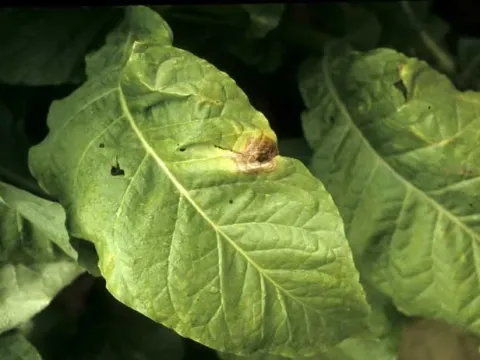
Phyllosticta leaf spot
Phyllosticta nicotianae
The disease typically manifests as small, circular or irregular spots on the tobacco leaves. These lesions are initially brown or greyish-brown and may have a darker border surrounding the affected area.
What the section contains
Phyllosticta leaf spot
As the infection progresses, the centers of the spots become lighter in color, often turning whitish or beige as the tissue dies. You will notice small black specks, known as pycnidia, appearing in the center of these necrotic lesions.
The damage usually starts on the lower leaves of the tobacco plant where humidity is higher and airflow is restricted. Under favorable conditions, these spots can expand and coalesce, covering large parts of the leaf surface.
In severe cases, the infected leaf tissue becomes brittle and may tear, significantly degrading the quality of the tobacco leaf. This makes the leaf unsuitable for high-quality tobacco products after curing.
Plants affected by this fungal infection show signs of stress, including premature yellowing and eventual leaf drop. The structural integrity of the leaf is compromised, rendering it low-grade during processing.
The causative agent is the fungus Phyllosticta nicotianae, an asexual pathogen that thrives by invading host tissues. The fungus reproduces by producing pycnospores housed within pycnidia found on the leaf surface.
These spores act as the primary inocula for the disease. They are easily dispersed across fields by splashing rain, irrigation water, wind currents, and even human movement during field maintenance.
The fungus can survive as a saprophyte in crop residues, such as dead leaves or stems left in the soil after harvest. It can also persist on various weed hosts within the Solanaceae family.
The fungal mycelium invades the epidermis of the tobacco leaf, causing cellular decay and necrosis as it extracts nutrients. It remains active throughout the growing season as long as moisture levels are adequate.
Due to its ability to form resilient structures, the pathogen can successfully overwinter in field debris, ensuring a new cycle of infection in the following growing season.
Phyllosticta leaf spot thrives in warm, humid weather conditions. High relative humidity and persistent rainy periods are the most critical factors for the rapid spread of the fungus.
Dense planting patterns reduce air circulation within the crop canopy, creating stagnant, humid microclimates that allow the spores to germinate quickly on leaf surfaces.
Excessive nitrogen fertilization encourages lush, rapid growth, which can make the tobacco leaves more susceptible to fungal entry. A balanced fertilization program helps maintain stronger cell walls.
Failure to implement a proper crop rotation schedule leads to an accumulation of fungal spores in the soil. Tobacco should not be replanted in the same field for several consecutive years.
Mechanical injuries caused by insects or field operations provide entry points for the pathogen. Keeping plants healthy and free from pest pressure is essential for minimizing infection rates.
The economic impact of Phyllosticta leaf spot is severe, primarily through the reduction of yield and quality. Infected leaves lose their market value because they do not cure uniformly.
Significant losses of up to 50% can occur in the leaf yield when the disease is not controlled. The structural degradation makes the leaves brittle, causing them to shatter during handling and packing.
The disease weakens the overall plant physiology, diverting vital metabolic energy from leaf development to defense. This results in thinner leaves with lower nicotine and aromatic compound profiles.
Processed tobacco from heavily infected fields often has an off-flavor and undesirable discoloration. This limits its utility for high-grade commercial tobacco blends.
The presence of the disease creates an infectious reservoir in the field, increasing the need for chemical inputs and sanitation efforts in future seasons.
The most effective strategy is a combination of cultural practices, including the use of resistant tobacco varieties and strictly adhering to crop rotation schedules.
Sanitation is critical; all tobacco debris must be collected and removed from the field after harvest. Deep plowing can help bury infected organic matter, speeding up decomposition.
- Ensure proper spacing between plants to maximize airflow.
- Regularly weed the fields to eliminate alternative host plants.
- Avoid over-fertilizing with nitrogen to maintain plant vigor.
Fungicide applications, particularly those containing copper, are effective at preventing the spread of the disease when applied during the early stages of the outbreak.
Monitoring the field for initial symptoms allows for targeted treatments. Early intervention stops the cycle of spore production, significantly reducing the impact of the disease on the entire crop.