
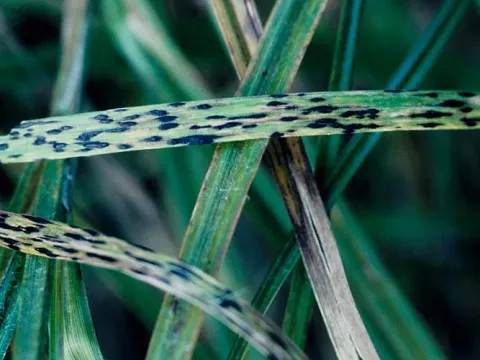
Phyllachora leaf spot
Phyllachora ischaemi
The causal agent of this disease is the ascomycete fungus Phyllachora ischaemi. As an obligate parasite, it primarily targets various wild and cultivated grass species, completing its life cycle within the host tissues throughout the growing season.
What the section contains
Phyllachora leaf spot
The fungus is characterized by the development of stromatic structures — dense mycelial mats that form within the leaf tissue. These structures serve both as reproductive centers and as a mechanism for the pathogen to overwinter on plant debris.
Classification-wise, it is a leaf-spotting fungus that disrupts the photosynthetic capacity of the host. By embedding itself deep into the mesophyll, the pathogen successfully extracts nutrients, leading to the characteristic visual symptoms observed on the foliage.
The infection cycle begins with the release of ascospores from the stromata, which are disseminated by wind or rain splash. Once they land on a susceptible host, they germinate and penetrate the epidermal layer, establishing a new site of infection.
Biological persistence is ensured by the robust nature of the fungal stromata. These structures are highly resistant to environmental fluctuations, allowing the pathogen to remain viable on crop residue until the return of favorable conditions.
The initial signs of Phyllachora leaf spot are small chlorotic patches that gradually darken. As the disease progresses, these spots evolve into characteristic black, glossy, and slightly raised stromata that look like small, hard crusts on the leaf surface.
These spots are often arranged in linear rows along the leaf veins, reflecting the internal anatomy of the grass host. In advanced stages of infection, these black structures become very prominent and can be observed on both the upper and lower sides of the leaves.
The tissue surrounding the stromata typically turns yellow (chlorotic) and later necrotic, indicating cell death due to the pathogen's metabolic activity. If the infection is severe, these spots coalesce, causing the entire leaf to wither and turn brown.
During periods of high humidity, the surface of the stromata may become slick or show minute openings where spores are produced. This physical evidence is a key indicator for field diagnosis, distinguishing it from other common fungal leaf spots.
It is important to note that the presence of these hard black structures is the most reliable diagnostic feature. Unlike saprophytic fungi that grow superficially, Phyllachora ischaemi is deeply integrated into the plant's structural tissues.
The development of Phyllachora leaf spot is heavily dependent on moisture. Prolonged rainy spells, high relative humidity, and heavy dew create the perfect microclimate for the germination of spores and the subsequent colonization of the leaf surface.
Temperature plays a significant role, with the pathogen showing optimal growth in the range of 18°C to 25°C. In these conditions, the incubation period is reduced, allowing the fungus to produce multiple generations during a single growing season.
Dense crop stands inhibit airflow, which keeps the leaf surface moist for longer periods. This microclimate is conducive to rapid spread, making dense or neglected fields more prone to severe outbreaks of the disease.
The presence of overwintering inoculum is a critical factor for early-season infections. Fields with heavy crop residue from the previous year, especially when monocropping is practiced, often exhibit higher initial disease pressure.
Plant vigor and nutrition influence the disease outcome. Potassium-deficient plants or those under other forms of stress are more susceptible to penetration, as their natural biochemical defenses against fungal ingress are often compromised.
The primary harm caused by Phyllachora leaf spot is the reduction of the photosynthetic surface area. By killing leaf tissue and disrupting normal physiological processes, the fungus limits the plant's ability to accumulate biomass and store energy.
In cereal crops, this leads to reduced grain fill, lower test weights, and compromised grain quality. The cumulative effect of photosynthesis loss across the entire plant can result in significant yield penalties in highly infected fields.
For forage grasses, the disease is particularly detrimental. Infected foliage has lower nutritional value and potentially lower palatability for livestock. In some cases, secondary metabolites produced by the fungus can impact animal health.
Severely infected plants show early senescence and reduced tillering capacity. This loss of vitality reduces the competitive ability of the grass, which can lead to thinning of the stand and invasion by opportunistic weed species.
The economic impact of the disease is amplified by the cost of management. In years conducive to the disease, farmers may face increased expenses for fungicides or may suffer losses that reduce the overall profitability of the agricultural operation.
Effective management begins with sanitation. Deep plowing or the complete removal of infected crop residue significantly reduces the primary inoculum source for the following season, limiting the initial spread of the fungus.
Implementing a robust crop rotation program helps disrupt the disease cycle. By alternating host grasses with non-host crops, the population of Phyllachora ischaemi in the field can be naturally depleted over time.
Maintaining balanced soil fertility, especially adequate potassium levels, strengthens the plant's physical and chemical barriers. A healthy crop is better equipped to resist infection and recover from minor disease pressure.
When necessary, chemical control using systemic fungicides can be highly effective. These treatments should be applied during the early stages of disease development to protect the developing foliage and prevent the formation of new stromata.
- Improve stand ventilation to reduce leaf moisture duration.
- Monitor crops frequently during the elongation and flowering stages.
- Select resistant cultivars to minimize reliance on chemical interventions.
- Remove volunteer plants that may serve as reservoirs for the pathogen.