
Phyllachora leaf spot of ficus
Phyllachora bakeriana
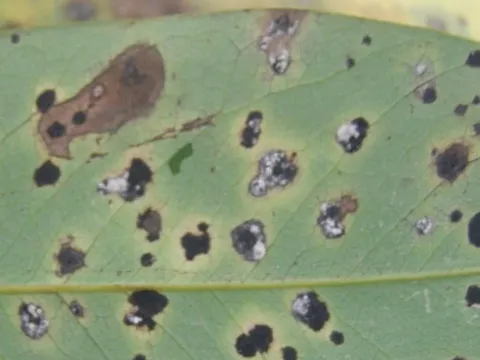
The primary symptom of Phyllachora bakeriana infection on Ficus is the emergence of distinct, necrotic leaf spots that progressively darken over time.
What the section contains
Phyllachora leaf spot of ficus
Initial signs appear as small chlorotic lesions, which eventually develop into dark brown or black spots, indicating the presence of fungal stroma.
These spots are often accompanied by a yellow halo, reflecting the localized death of plant tissue and the physiological stress caused by the pathogen.
As the infection advances, multiple spots may coalesce, significantly reducing the green surface area of the leaves and causing premature defoliation.
Under close inspection, the underside of the leaves may reveal raised, dense fungal structures where the pathogen completes its reproductive cycle.
The disease is caused by the ascomycete fungus Phyllachora bakeriana, a specialized pathogen that exclusively targets species within the Ficus genus.
As an obligate parasite, the fungus relies on the host plant to fulfill its biological requirements, developing deep within the leaf mesophyll tissues.
The fungus produces spores that are easily disseminated by water splashes during irrigation or by wind currents within greenhouse or indoor environments.
The survival of the pathogen is facilitated by its ability to remain dormant in fallen leaf litter, acting as a reservoir for recurring infections.
Scientific studies confirm that this fungus is specifically associated with the necrotic spotting phenomenon, distinguishing it from general physiological leaf drop.
Phyllachora leaf spot thrives in environments characterized by high relative humidity and poor air circulation, which are common in indoor collections.
Prolonged moisture on the leaf surface is a critical trigger for spore germination and successful fungal colonization of healthy plant tissue.
Optimal growth temperatures for the fungus typically range between 20°C and 28°C, which align with standard indoor temperatures for Ficus maintenance.
Overcrowding plants limits evaporation and airflow, creating micro-environments with sustained high humidity that favor the rapid spread of the disease.
Plants experiencing stress due to inconsistent watering or inadequate light levels exhibit lower resistance to fungal invasion and suffer more severe symptoms.
The most immediate harm caused by this disease is the severe degradation of the plant's aesthetic value, which is critical for ornamental Ficus species.
Chronic infection disrupts the photosynthetic efficiency of the leaves, resulting in stunted growth and a general decline in the plant's vigor.
The loss of leaves due to premature senescence weakens the plant, making it significantly more susceptible to secondary pests and additional opportunistic pathogens.
In nursery settings, the presence of Phyllachora bakeriana can lead to significant economic losses as infected batches become unfit for commercial sale.
If left unmanaged, the pathogen can spread through an entire collection, leading to extensive plant damage and potential loss of valuable specimens.
Effective management begins with strict sanitation, involving the prompt removal and destruction of all infected leaves to minimize inoculum density.
Adjusting horticultural practices is essential: avoid overhead watering and ensure adequate spacing between plants to improve airflow and reduce humidity.
Chemical control involving systemic fungicides, particularly those recommended for ascomycete leaf spots, can be applied to suppress fungal development.
Integrating biological control agents can help build plant resistance and maintain a healthier growing environment without excessive reliance on synthetic chemicals.
Ongoing monitoring and the sterilization of tools are vital components of a comprehensive preventative strategy to protect Ficus collections from recurring outbreaks.