
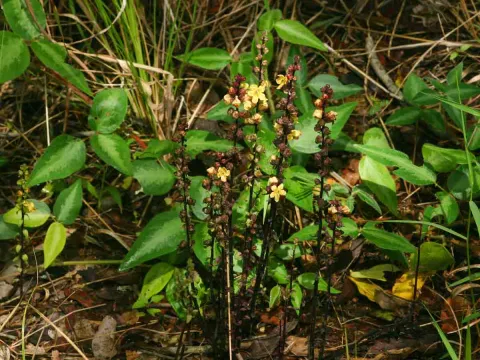
Alectra
Alectna
Alectra (Alectra vogelii) is an obligate hemiparasitic plant belonging to the Orobanchaceae family. Unlike conventional weeds, it lacks chlorophyll and cannot perform photosynthesis, making it entirely dependent on its host plant for survival.
What the section contains
Alectra
The parasite attaches to the roots of its host using specialized structures called haustoria. These organs penetrate the host's root tissue and connect directly to the vascular system (xylem and phloem) to extract water and nutrients.
Alectra's lifecycle is triggered by chemical signals known as strigolactones, which are exuded by the host's roots into the soil. This mechanism ensures that the parasite only germinates when a suitable host is present nearby.
After successful attachment, the parasite develops a subterranean network of roots before emerging above ground to produce stems, leaves, and eventually flowers that bloom to produce thousands of microscopic seeds.
These seeds are highly resilient and can remain dormant in the soil for many years, waiting for the chemical cues of a suitable host plant to restart the infection process.
The first visual signs of infestation include severe stunting of the host plant. Peanuts appear chlorotic, develop yellow leaves, and exhibit symptoms of wilting even when soil moisture levels are adequate for non-infested plants.
Above-ground, Alectra presents as a small herb, typically 10-30 cm tall, with scale-like leaves. Depending on the species and growth stage, the stems may appear yellow, brown, or purplish due to their lack of chlorophyll.
During the flowering period, the parasite produces bright yellow flowers, which are the most obvious diagnostic feature, making the infested areas of the field easy to identify during the active growing season.
Exposing the root system of an affected peanut plant will reveal the parasitic attachments. These haustoria appear as small, whitish or cream-colored nodules that are firmly embedded in the host's primary or secondary roots.
Infestations typically start in small patches within a field. These patches gradually expand over time as seeds are dispersed by wind, water, or farm machinery during routine cultivation activities.
Alectra is most prevalent in tropical and subtropical regions, favoring sandy, low-fertility soils. Its development is often exacerbated by drought conditions, which stress the host plant and weaken its defensive mechanisms.
High soil temperatures in conjunction with moderate moisture levels provide the ideal environment for the parasite's seeds to germinate and successfully attach to the roots of the target crop.
Poor agricultural practices, particularly continuous monocropping of legumes, lead to a massive buildup of the seed bank in the soil, making it increasingly difficult to cultivate susceptible crops.
The spread of Alectra is facilitated by the movement of contaminated soil. Farm machinery that is not thoroughly cleaned after operating in infested fields acts as a primary vector for spreading the parasite to clean land.
The planting density of the host crop also plays a role; high-density legume plantations create a continuous network of root signals, promoting rapid and uniform germination of the parasitic weed across the entire plot.
Alectra is a major threat to peanut (Arachis hypogaea) production, as well as cowpea, soybean, and other legumes. In heavily infested fields, yield losses can reach 50% to 100%, causing severe economic distress to farmers.
The parasite siphons off essential nutrients and photosynthates intended for pod development. As a result, infested plants produce fewer pods, which are often shriveled, deformed, and of significantly lower market value.
Beyond direct nutrient theft, Alectra induces physiological stress in the host. This stress makes the peanut plants more susceptible to opportunistic fungal and bacterial pathogens, leading to further crop deterioration.
The infestation often leads to total crop failure in affected sections of the field. Furthermore, the longevity of the seeds in the soil forces farmers to avoid planting legumes for many years, disrupting traditional crop rotations.
Secondary damage includes increased costs for weed management, loss of land utility, and the requirement for expensive remedial actions to restore soil health and eliminate the parasite's seed bank.
The most effective strategy is the implementation of long-term crop rotation. Rotating susceptible legumes with non-host crops like cereals or grasses for at least 3-5 years helps deplete the Alectra seed bank in the soil.
Mechanical control, such as manual hand-pulling or hoeing, is effective if done before the parasite flowers. Once the plant has flowered and produced seeds, it must be carefully collected and destroyed, preferably by burning.
Selecting and breeding resistant or tolerant peanut varieties is the most sustainable approach. Research into varieties that prevent haustoria attachment or exhibit low strigolactone exudation is ongoing.
Strict sanitation measures are crucial. Cleaning farm equipment before moving from infested to clean fields is essential to prevent the introduction of the parasite to previously healthy agricultural land.
Trap cropping and the use of chemical germination stimulants are innovative control methods currently being studied. These techniques aim to trigger 'suicidal germination' of the weed seeds in the absence of a host.