
Oidiopsis
Oidiopsis
The causative agent of this disease is the endophytic fungus Leveillula taurica (anamorph Oidiopsis taurica). Unlike most powdery mildew fungi that grow on the surface, the mycelium of this pathogen develops primarily inside the plant tissue, within the intercellular spaces.
What the section contains
Oidiopsis
The pathogen enters the plant through the stomata. Only the conidiophores and conidia emerge through the stomatal openings, forming the characteristic whitish or grayish powdery appearance on the leaf surface.
The fungal life cycle involves asexual reproduction via conidia dispersed by wind currents. Under certain conditions, the fungus may produce cleistothecia, which allow it to survive in harsh environmental conditions.
The inoculum can persist in plant debris, soil, and on various weed hosts, acting as a reservoir for the disease throughout the year.
This pathogen affects a wide range of crops, including major vegetables like tomatoes, peppers, eggplants, and cucumbers, as well as various leguminous and ornamental plants.
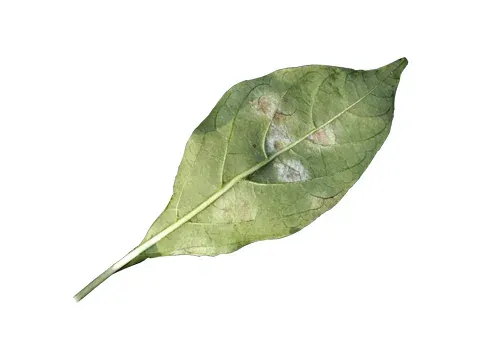
The initial symptoms include the appearance of chlorotic spots on the upper side of the leaves. Over time, these spots become necrotic and turn brown, indicating tissue collapse.
On the underside of the leaves, a sparse white or dusty growth appears corresponding to the chlorotic areas. This helps distinguish it from other forms of powdery mildew which often cover the entire leaf surface.
As the disease progresses, leaves become curled, brittle, and eventually drop prematurely, typically starting from the lower parts of the plant canopy.
The plant exhibits stunted growth, reduced vigor, and poor flowering, which directly impacts the formation and development of fruits.
Detection can be challenging in early stages, as the internal mycelial growth often precedes the emergence of conidiophores on the leaf surface.
Oidiopsis thrives in warm and humid conditions, with optimal development occurring at temperatures between 20°C and 30°C. Greenhouse environments provide an ideal stable microclimate for the pathogen.
High relative humidity and poor air circulation within the plant canopy facilitate the germination of spores and their subsequent penetration into the leaf stomata.
Dense plant spacing and excessive nitrogen fertilization make crops more susceptible to infection by weakening the structural integrity of the leaf tissues.
Wind and fluctuating temperatures are significant factors in the dissemination of conidia, allowing the fungus to spread rapidly across a field or greenhouse facility.
The presence of susceptible weed hosts surrounding the cultivated area can serve as a constant source of reinfection throughout the growing season.
The primary damage caused by Oidiopsis is the significant reduction in photosynthetic leaf area, which severely inhibits the metabolic processes of the host plant.
The premature loss of foliage leads to sunscald on exposed fruits, which diminishes their marketability, size, and overall quality, resulting in substantial financial losses.
In severe cases, the disease can lead to complete defoliation, causing a collapse of the plant and rendering it incapable of producing a harvestable yield.
The weakened state of the plants makes them more vulnerable to secondary infections from bacteria and other fungi, complicating the recovery process.
Management of the disease is costly, requiring repeated applications of systemic fungicides and complex sanitation measures to prevent future outbreaks.
The most effective strategy involves the use of resistant or tolerant cultivars, combined with strict sanitation practices such as the removal and destruction of crop residues.
Systemic fungicides are essential for controlling the disease, as they can penetrate leaf tissues to reach the internal mycelium, unlike contact fungicides which are less effective.
Providing optimal growing conditions, including proper ventilation and avoiding dense planting, is crucial to limiting the development of the microclimate required by the fungus.
Integrated Pest Management (IPM) practices, including the use of biocontrol agents like Bacillus subtilis, can help suppress the disease at its onset.
- Regular monitoring of the lower leaf surfaces for early signs of infection.
- Strict weed control programs to eliminate host reservoirs.
- Rotating crops to break the life cycle of the pathogen in the soil.